
Table of Contents
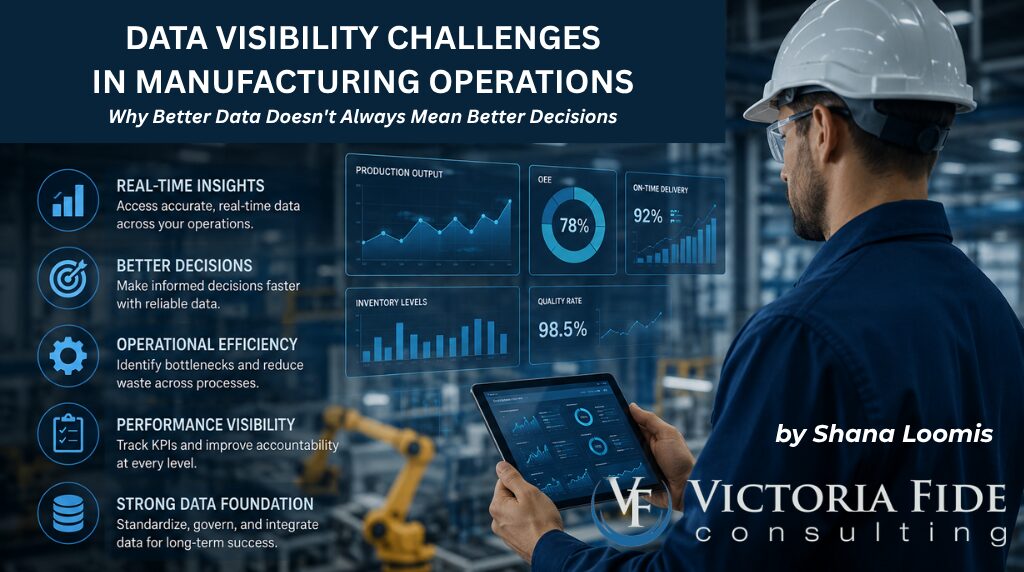
Data Visibility Challenges in Manufacturing Operations
Why Better Data Doesn’t Always Mean Better Decisions
Why Data Visibility Matters in Manufacturing
Manufacturers generate enormous amounts of data every day. Information flows through:
- Production systems
- ERP platforms
- Supply chain tools
- Inventory systems
- Financial applications
- Quality management processes
The challenge is not the lack of data. The challenge is turning that data into actionable insights that support operational decision-making. Without visibility, organizations often struggle to:
- Identify operational bottlenecks
- Respond to production issues quickly
- Forecast accurately
- Manage inventory effectively
- Measure performance consistently
Data visibility is no longer simply a reporting issue. It is an operational performance issue.
What Data Visibility Actually Means
Data visibility refers to an organization’s ability to access, understand, and use accurate information across the business. Effective visibility provides stakeholders with:
- Real-time operational insights
- Consistent reporting
- Reliable performance metrics
- Clear decision-making support
Visibility is not simply having access to reports. It means decision-makers can trust the information they are using to run the business.
Why Manufacturers Struggle with Visibility
Many manufacturing organizations have accumulated systems and processes over time. As operations grow, data often becomes fragmented across:
- Multiple applications
- Spreadsheets
- Legacy systems
- Department-specific tools
This creates situations where:
- Different teams report different numbers
- Data is manually reconciled
- Reports require extensive manipulation
- Decision-making slows down
The Victoria Fide article Digital Transformation Challenges highlights how disconnected systems and poor alignment often create operational friction and reporting challenges.
The Most Common Data Visibility Challenges
Manufacturers often experience similar visibility issues regardless of size or industry.
Disconnected Systems
Many organizations operate with systems that do not communicate effectively. Examples include:
- ERP platforms
- Manufacturing execution systems
- Inventory applications
- Financial reporting tools
Disconnected systems create data silos and inconsistent reporting.
Manual Reporting Processes
When reporting relies heavily on spreadsheets and manual manipulation:
- Accuracy declines
- Reporting takes longer
- Trust in data decreases
Teams spend more time gathering information than acting on it.
Inconsistent Data Definitions
Different departments often define metrics differently. For example:
- Inventory availability
- Production efficiency
- Order status
- Customer delivery performance
Without standard definitions, reporting becomes unreliable.
Poor Data Governance
Many organizations lack clear ownership of critical business data. This often results in:
- Duplicate records
- Incomplete information
- Reporting inconsistencies
Strong governance is essential for long-term visibility.
Limited Real-Time Access
By the time reports are produced, the information may already be outdated. Manufacturers increasingly require near real-time visibility to support operational decision-making.
New tool from Victoria Fide
Find out where your implementation risk actually sits.
100+ structured questions. Six domains. Instant results.
Start the DX Implementation Risk Assessment free — evaluate your organization across the six domains most commonly behind ERP and digital transformation failures. Unlock the full analysis with prioritized action items for $297.
How Data Visibility Impacts Implementation Risk
Data visibility issues are often viewed as reporting problems, but they can create significant implementation risks during digital transformation and ERP initiatives. When organizations lack visibility into their data, they often encounter challenges such as:
- Incomplete or inconsistent business requirements
- Reporting and analytics gaps
- Data migration issues
- Limited stakeholder alignment
- Reduced confidence in decision-making
These challenges can increase project complexity, delay timelines, and impact adoption after go-live. Before beginning a major transformation initiative, organizations should understand whether data readiness, governance, and reporting structures are positioned to support long-term success.
This is one of the reasons Victoria Fide developed the DX Implementation Risk Assessment. The assessment helps organizations evaluate potential implementation risks before execution begins by examining critical readiness areas including:
- Leadership & Governance Readiness
- Project Management Effectiveness
- Business Requirements Alignment
- Data Management & Readiness
- Testing & Quality Assurance
- Team Support & Change Management
By identifying potential risks early, organizations can address issues proactively rather than reacting to them during implementation. Learn more about the DX Implementation Risk Assessment.
How Poor Visibility Impacts Operational Performance
Data visibility challenges often lead to broader business issues. Common impacts include:
- Delayed decision-making
- Excess inventory
- Production inefficiencies
- Missed customer commitments
- Reduced profitability
When leaders cannot trust the data, decisions become slower and more reactive. The result is often higher costs and reduced operational agility.
Building a Strong Data Foundation
Improving visibility begins with establishing a strong data foundation. Organizations should focus on:
- Standardizing Data: Consistent definitions improve reporting accuracy across departments.
- Improving Data Quality: Reliable data creates confidence in operational and strategic decisions.
- Defining Ownership: Clear accountability helps ensure data remains accurate and maintained.
- Aligning Reporting to Business Objectives: Reports should support decision-making rather than simply provide information.
Visibility should help leaders answer important business questions quickly.
The Role of ERP and Integrated Systems
ERP systems often serve as the operational backbone of manufacturing organizations. When properly aligned, ERP platforms help:
- Centralize information
- Improve reporting consistency
- Support cross-functional visibility
- Enable more informed decision-making
However, technology alone is not enough. The Victoria Fide article Defining Your DX Project: Bridging the Gap Between Strategy and Execution explains how technology must align with operational processes and business goals to create meaningful outcomes. Organizations that struggle with visibility often discover the issue is not the ERP system itself, but the processes, governance, and data structures supporting it.
The Role of Advisors in Improving Data Visibility
Many organizations engage advisors to assess reporting, systems, and operational alignment. Advisors can help by:
- Identifying visibility gaps
- Evaluating reporting processes
- Improving data governance
- Aligning systems and workflows
- Creating visibility roadmaps
Firms like Victoria Fide Consulting focus on helping organizations improve operational performance through better alignment between data, technology, and business processes. This approach helps organizations move beyond reporting challenges and build a stronger foundation for transformation success.
Leadership’s Role in Data-Driven Operations
Leadership plays a critical role in improving organizational visibility. Executives influence outcomes by:
- Prioritizing data quality
- Supporting governance initiatives
- Reinforcing accountability
- Aligning reporting to business goals
Data visibility becomes a competitive advantage when leadership actively uses information to guide decision-making and operational improvements.
Next Steps for Improving Data Visibility
Organizations looking to improve visibility should consider the following steps:
- Assess current reporting and data management processes
- Identify disconnected systems and manual workarounds
- Standardize key business metrics and definitions
- Improve governance and data ownership
- Evaluate organizational readiness before launching transformation initiatives
- Leverage tools such as the DX Implementation Risk Assessment to identify risks before they impact project success
- Align reporting with operational and strategic objectives
These actions help create a stronger foundation for operational performance, transformation success, and long-term growth.
Resources
Victoria Fide Consulting Resources
- DX Implementation Risk Assessment: Evaluate your organization’s readiness before launching a digital transformation, ERP implementation, or operational modernization initiative. The assessment helps identify implementation risks early and provides actionable insights to improve project success.
- Victoria Fide Consulting – Business & Technology Optimization
- ERP Implementation Recovery
Victoria Fide Blog Articles
- Digital Transformation Challenges
- What It Takes to Succeed in Digital Transformation
- Defining Your DX Project: Bridging the Gap Between Strategy and Execution
Industry Resources
- Gartner – Data & Analytics Research
- Microsoft – Manufacturing Data & Analytics
- McKinsey – Manufacturing Operations & Digital Performance
70%
of ERP initiatives fail to fully meet their original business case goals
Gartner, 2024
The warning signs are there before go-live. Are you seeing them?
Victoria Fide’s DX Implementation Risk Assessment evaluates your project across the six domains that account for most implementation failures — leadership, project management, requirements, data, testing, and OCM. See your score instantly, free.
Start the DX Implementation Risk Assessment — free to complete, with instant results across all six domains. Unlock the detailed findings and prioritized action items for $297.