
Table of Contents
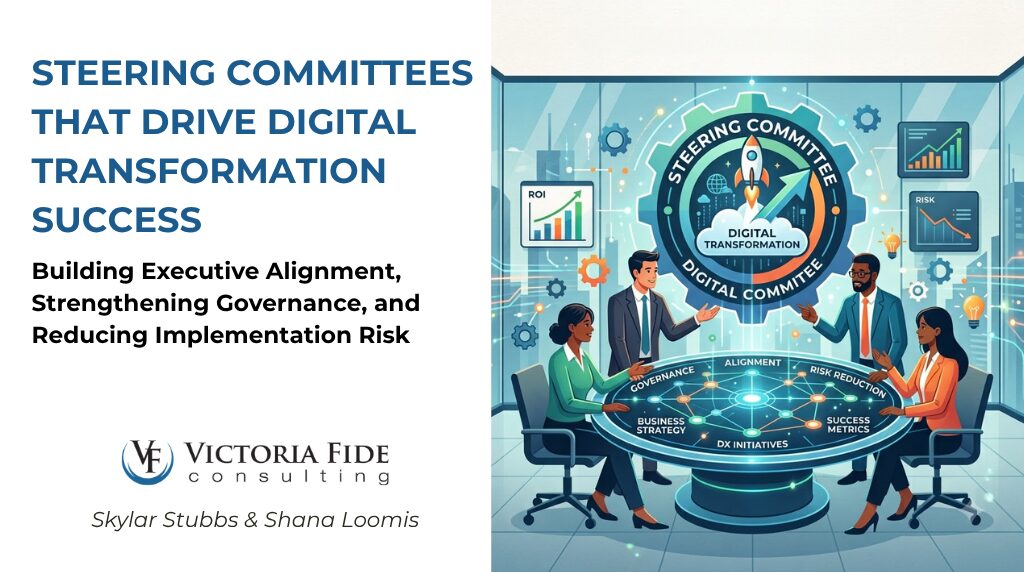
Steering Committees That Drive Digital Transformation Success
Building Executive Alignment, Strengthening Governance, and Reducing Implementation Risk
Why Executive Governance Matters More Than Ever
Digital transformation initiatives are among the largest and most strategic investments an organization will make. Whether implementing a new ERP platform, modernizing business processes, improving operational efficiency, or scaling for future growth, success depends on much more than selecting the right technology.
It depends on leadership.
Organizations that consistently deliver successful transformation initiatives share one important characteristic: strong executive governance. They establish clear decision-making authority, align stakeholders around measurable business objectives, and proactively identify implementation risks before execution begins.
An effective steering committee becomes the foundation of that governance. Rather than serving as another project meeting, a steering committee provides executive oversight that keeps transformation initiatives aligned with business strategy, removes organizational barriers, supports cross-functional collaboration, and helps leadership make informed decisions throughout the project lifecycle.
Simply put, technology enables transformation, but executive leadership determines whether transformation succeeds.
What Is a Digital Transformation Steering Committee?
A steering committee is a cross-functional group of executive leaders and key business stakeholders responsible for guiding the strategic direction of a digital transformation initiative. While project managers oversee day-to-day execution, the steering committee remains focused on the bigger picture by ensuring the initiative continues supporting organizational priorities, operational goals, and long-term business strategy.
An effective steering committee helps organizations:
- Align business and technology strategies
- Prioritize business objectives
- Provide executive oversight
- Resolve cross-functional challenges
- Monitor implementation risk
- Support organizational change
- Improve communication across departments
- Ensure accountability throughout the project
Its purpose is simple: ensure every major project decision contributes to measurable business outcomes.
Why Executive Governance Determines Project Success
Many transformation initiatives struggle not because of the technology itself, but because leadership wasn’t aligned before implementation began.
Common challenges include:
- Conflicting departmental priorities
- Unclear ownership and accountability
- Poorly defined business requirements
- Delayed executive decisions
- Scope changes
- Weak governance
- Low user adoption
Without strong executive governance, these issues often grow throughout implementation, increasing project complexity, delaying timelines, and reducing return on investment.
Strong governance helps organizations:
- Align business and technology strategies
- Prioritize business requirements
- Resolve issues before they become project risks
- Maintain executive sponsorship
- Improve organizational communication
- Reduce implementation risk
When leadership remains engaged from planning through execution, organizations are significantly more likely to achieve successful transformation outcomes.
Building An Effective Steering Committee
An effective steering committee should represent both strategic leadership and operational expertise.
Typical committee members include:
- Executive Sponsor
- Operations Leadership
- Finance Leadership
- Information Technology Leadership
- Business Process Owners
- Project Leadership
- Change Management Representatives
- Other key stakeholders affected by the initiative
Committee members should possess the authority to make strategic decisions, allocate resources, remove organizational barriers, and ensure business priorities remain aligned throughout the project.
Most importantly, they should be committed to the long-term success of the organization, not just the success of the project.
70%
of ERP initiatives fail to fully meet their original business case goals
Gartner, 2024
The warning signs are there before go-live. Are you seeing them?
Victoria Fide’s DX Implementation Risk Assessment evaluates your project across the six domains that account for most implementation failures — leadership, project management, requirements, data, testing, and OCM. See your score instantly, free.
Start the DX Implementation Risk Assessment — free to complete, with instant results across all six domains. Unlock the detailed findings and prioritized action items for $297.
Best Practices for Steering Committee Success
High-performing steering committees share several common characteristics.
Meet Consistently
Maintain a regular meeting cadence that keeps leadership informed while allowing timely decision-making.
Focus on Strategy
Meetings should concentrate on executive decisions, project health, organizational readiness, and implementation risks, not detailed project tasks.
Monitor Organizational Readiness
Review business readiness, stakeholder alignment, training progress, and change management activities throughout the implementation.
Review Risks Proactively
Identify implementation risks early and assign ownership before they impact timelines or budgets.
Measure Business Outcomes
Evaluate success using meaningful KPIs tied to operational performance and business objectives, not simply project completion dates.
Encourage Cross-Functional Collaboration
Transformation impacts every part of the organization. Steering committees should reinforce collaboration between departments and maintain consistent executive communication throughout the initiative.
Governance Starts Before Implementation
One of the biggest misconceptions surrounding steering committees is that governance begins once implementation starts.
In reality, the strongest governance begins long before technology is selected.
Early governance allows leadership to:
- Validate strategic objectives
- Confirm business priorities
- Define project success
- Establish decision-making authority
- Identify organizational gaps
- Improve stakeholder alignment
Organizations that invest in governance early often avoid costly implementation challenges later in the project lifecycle.
Strengthening Governance with the DX Implementation Risk Assessment
Strong governance becomes even more effective when executive decisions are supported by objective readiness data.
That’s why Victoria Fide developed the DX Implementation Risk Assessment.
Rather than relying on assumptions, the assessment helps organizations evaluate implementation readiness before execution begins by identifying risks across six critical areas:
- Leadership & Governance Readiness
- Project Management Effectiveness
- Business Requirements Alignment
- Data Management & Readiness
- Testing & Quality Assurance
- Team Support & Change Management
These insights help steering committees:
- Prioritize executive decisions
- Improve implementation planning
- Identify organizational risks early
- Strengthen governance
- Increase organizational readiness
- Improve long-term project success
Instead of reacting to challenges during implementation, organizations gain the information needed to address potential issues before they impact execution.
Learn more about the DX Implementation Risk Assessment.
Why Victoria Fide Takes a Different Approach
At Victoria Fide, successful transformation starts with business outcomes, not technology.
Our Business & Technology Optimization approach aligns executive leadership, operational processes, governance, and technology decisions to improve efficiency, performance, and scalability.
Rather than reacting to implementation issues after go-live, we help organizations identify risks early, improve organizational readiness, strengthen executive governance, and build a stronger foundation for transformation success.
Because successful digital transformation isn’t just about implementing new technology. It’s about preparing the organization to use that technology successfully.
Conclusion
An effective steering committee is far more than a governance requirement. It is one of the strongest predictors of successful digital transformation.
Organizations that invest in executive alignment, organizational readiness, and proactive risk management consistently improve project outcomes, strengthen collaboration, and maximize the value of their technology investments.
Before launching your next ERP implementation or digital transformation initiative, take time to evaluate both your governance structure and your organizational readiness.
Strong leadership, informed decision-making, and early risk identification create the foundation for successful execution.
Resources
Victoria Fide Resources
- DX Implementation Risk Assessment – Evaluate your organization’s readiness before launching a digital transformation or ERP initiative by identifying implementation risks early and strengthening executive decision-making.
- ERP Implementation Recovery
- Business & Technology Optimization
Related Victoria Fide Articles
- Digital Transformation Challenges
- Defining Your DX Project: Bridging the Gap Between Strategy and Execution
- What It Takes to Succeed in Digital Transformation
Victoria Fide Thought Leadership
- Skylar Stubbs – Original Author: This article is based on the original thought leadership and content developed by Skylar Stubbs, whose expertise in digital transformation, technology strategy, and enterprise implementations helped shape Victoria Fide’s perspective on executive governance and steering committee effectiveness. As a leader at Victoria Fide, Skylar has focused on helping organizations align technology initiatives with business objectives, improve implementation success, and drive measurable operational outcomes.
- Adele Graser – COO: This article builds upon Adele Graser’s original thought leadership surrounding executive governance, stakeholder alignment, and steering committee effectiveness. Her work continues to provide practical guidance for organizations leading complex digital transformation initiatives.
- Tory Bjorklund – CEO: This refreshed version reflects Victoria Fide’s execution-first philosophy, emphasizing implementation readiness, executive governance, operational alignment, and reducing project risk before implementation begins. His perspective reinforces that successful transformation starts by aligning business strategy, people, processes, and technology before execution.
New tool from Victoria Fide
Find out where your implementation risk actually sits.
100+ structured questions. Six domains. Instant results.
Start the DX Implementation Risk Assessment free — evaluate your organization across the six domains most commonly behind ERP and digital transformation failures. Unlock the full analysis with prioritized action items for $297.