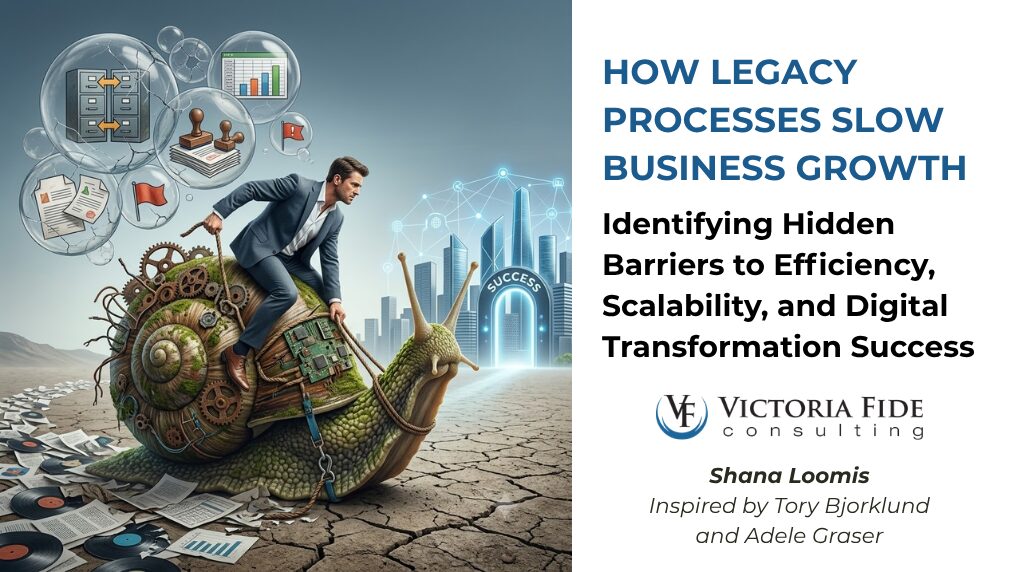
How Legacy Processes Slow Business Growth
Table of Contents How Legacy Processes Slow Business Growth Identifying Hidden Barriers to Efficiency, Scalability, and Digital Transformation Success Why...
Victoria Fide's process work is independent of any platform — focused on how your business needs to operate, not on what any particular system does well.
Start With a Process ConversationBefore a technology initiative. Mid-implementation. After go-live when results haven't materialized. The entry point is yours — the methodology is the same.
of business transformations achieve their goals as originally defined.
Bain & Company, 2024 — analysis of 24,000 transformation initiatives
For the other 88%, the gap between what the initiative promised and what it delivered is almost always traceable to the same place: the processes the new system was built on top of.
When a new system goes live on top of inefficient processes, the system doesn't fix them. It runs them faster. The delays, the workarounds, the duplicate approvals, the unclear ownership — they survive the implementation. Sometimes they get worse, because now they're embedded in a system that cost millions of dollars and took years to deploy.
The organizations that get full value from their technology investments treat process improvement seriously: before the initiative starts, alongside it, or after it becomes clear that go-live was not the same thing as success.
For executive leaders who know their operations need to work better and understand that technology alone won't get them there.
You know a significant technology initiative is coming and want your processes assessed, documented, and redesigned before execution begins — so the initiative is built on solid ground rather than inherited problems. Victoria Fide's process work at this stage feeds directly into ERP Implementation Readiness, where the preparation work for the initiative itself is done.
You're in the middle of a technology initiative and process design decisions are running ahead of process improvement work. Victoria Fide integrates into the initiative to provide the process clarity that configuration, testing, and training require — working alongside ERP Implementation Advisory and Support or independently, depending on what your situation calls for.
Your system is live but the expected results haven't materialized. Victoria Fide assesses where the process gaps are and does the work to close them. If the implementation itself needs attention alongside the process work, ERP Recovery addresses that layer.
An objective picture of how work actually moves through the organization today — not how it's documented, and not how leadership believes it operates, but how it actually happens.
That assessment looks at more than workflow. From the first day, Victoria Fide identifies organizational change management risks alongside process gaps, because the two are inseparable.
Before redesign work begins, Victoria Fide works with leadership to define specific, measurable outcomes — what better actually looks like for this organization, not in general.
Processes are designed with both technology and people in mind, with full awareness of what relevant systems can and cannot support — and what the organization needs to believe to adopt them.
Redesigned processes that no one is accountable for maintaining revert. Victoria Fide engages the people who will actually run the new processes — ensuring they understand, can execute, and have the authority to maintain them.
At the close of the engagement, results are measured against the success criteria established at the start. The engagement isn't considered complete until they are.
Engagements are scoped to your situation. Fixing process problems before or during an initiative costs a fraction of what they cost to fix after one.
Start With a Process ConversationMost process work gets done by people who are also aligned to a specific system — implementation consultants whose expertise is in configuring a platform, not in questioning whether the process being configured is the right one. A consultant with a platform certification has limited incentive to recommend a process that doesn't match how that platform is typically deployed.
Victoria Fide's process work starts with your business — how it actually operates today, what it needs to operate better, and what your people will realistically adopt. No platform preference shapes that assessment. Future-state processes are designed around your operations and objectives, then aligned to what modern systems can support. That sequence matters: process first, system second.
Victoria Fide holds no certifications that create incentive to fit your processes to a vendor's preferred deployment pattern.
The future state is designed around your operations and objectives. System capabilities inform it — they don't define it.
Success criteria are defined before redesign begins. The engagement isn't considered complete until results are measured against them — and the Client Success Guarantee applies.
For organizations implementing or planning to implement a new system, this work feeds directly into the implementation: the process clarity that configuration decisions, testing, and training require.
Victoria Fide peeled apart our business process and challenged us on why things are the way they are. I loved that because that is exactly what we needed."
Processes drift. Organizations change. Systems get updated. For clients in longer-term relationships, process health is maintained through the Sustain phase of Victoria Fide's engagement model — not handed off at go-live.
Ask about ongoing process advisory →Answers to what executive leaders ask most before engaging.
Engagements are scoped to your situation — fixing process problems before or during an initiative costs a fraction of what they cost to fix after one.
Table of Contents How Legacy Processes Slow Business Growth Identifying Hidden Barriers to Efficiency, Scalability, and Digital Transformation Success Why...
Table of Contents Why Business Process Mapping MattersOrganizations cannot improve processes they do not fully understand.As businesses grow, workflows often...
Table of Contents Why Measuring ROI Is Critical to Technology InvestmentsOrganizations invest heavily in technology to improve efficiency, reduce costs,...