Your ERP Implementation Needs a Manager Whose Only Job Is Running It Well.

The organizations that navigate ERP implementations successfully aren't the ones with the best software. They're the ones that managed the project with discipline — from kickoff through go-live. Victoria Fide provides the experienced, dedicated project leadership most organizations don't have any reason to keep in-house.

What this engagement covers

Project governance, detailed project management, and steering committee leadership — functioning together as the management operating system of a well-run implementation, from kickoff through go-live.

The Pattern
Milestone dates get treated as fixed when milestone criteria are the thing that should be fixed.

Most Organizations Don't Have This Discipline In-House — Not Because They Lack Capable People

ERP implementations are expensive, complex, and long. They involve dozens of stakeholders, hundreds of decisions, and a timeline that stretches across months or years. A manufacturing company's core competency is manufacturing. A distribution company's core competency is distribution. Neither has a standing team of experienced ERP project managers on the payroll — and even when an internal project administrator is assigned, they're typically managing the most complex initiative of their career while still holding down their day job.

The result is predictable. Scope expands in small increments, each one defensible in isolation, until the project has grown significantly beyond what was planned. Risks stay in the status report week after week because nobody with the authority to act on them has been made to look at them directly. And the steering committee — if one exists — hears status updates rather than making decisions.

By the time these patterns become visible, they're expensive to reverse.

Victoria Fide's ERP Project Management & Governance engagement provides what most organizations are missing: experienced, dedicated project leadership on the client's side of the table, from the moment execution begins through a successful go-live.

What ERP Project Management & Governance Covers

This engagement covers the discipline and accountability layer of an ERP implementation. It's concerned with how the project is run: whether it's being managed against the right criteria, whether decision-making has the right structure, and whether the organization has genuine visibility into where the project actually stands. The subject matter expertise that determines whether the right solution is being built belongs to Victoria Fide's ERP Implementation Advisory and Support service. The two engagements are complementary and can run concurrently on the same initiative.

The engagement runs from kickoff through go-live, covering three areas: project governance, detailed project management, and steering committee leadership. These aren't independent workstreams — they function together as the management operating system of a well-run implementation.

For organizations that completed Victoria Fide's ERP Implementation Readiness engagement, the project management plan, governance framework, and success criteria built there carry directly into this engagement. Victoria Fide operationalizes that foundation through execution, holding the project accountable to the decisions made before execution began. For organizations entering at this stage, Victoria Fide establishes that foundation before execution begins.

The Management Operating System
Project Governance Decision rights, escalation paths, milestone criteria tied to readiness
Detailed Project Management Honest status reporting, scope discipline, budget accountability
Steering Committee Leadership Real decision authority, equipped members, structured decisions

Runs from kickoff through go-live. Complementary to ERP Implementation Advisory and Support — the two can run concurrently on the same initiative.

Who Engages This Service

For Organizations That Don't Have the Dedicated Project Management Capability This Requires

This service is for organizations that have an ERP implementation underway — or one about to start — and don't have the dedicated project management capability to run it at the level the project requires. That typically describes one of three situations.

Situation 01

No Dedicated PMO

The organization doesn't have a project management office or a standing team with ERP implementation experience. The internal person assigned is capable, but this is the most complex initiative they've managed — while still covering their existing responsibilities. Victoria Fide provides the experienced project leadership the project requires without requiring the organization to hire it permanently.

Situation 02

Insufficient Bandwidth

The internal team has the skills but not the capacity. The project requires more active management than anyone in the organization can absorb alongside their current workload. Victoria Fide steps in to carry the load that can't be distributed internally.

Situation 03

A Project Already in Trouble

The implementation has started, and something about its trajectory isn't right. Milestones are slipping, scope is expanding in ways that weren't planned for, and the status reports look acceptable but leadership doesn't feel confident about where things actually stand. Victoria Fide assesses the current state and establishes the discipline the project needs to get back on solid footing.

How the Engagement Works

Three Areas, One Management Operating System

Governance

Project Governance

Every significant decision in an ERP implementation needs a home — a defined process for making it, a clear record that it was made, and accountability for following through. Without that structure, decisions accumulate in the space between the implementation vendor and the internal team, made informally and inconsistently.

  • Documented decision rights, established before execution begins
  • Escalation paths so issues don't stall at the wrong level of the organization
  • Milestone criteria that reflect actual project readiness, not just the calendar
  • Authority to hold a milestone open until the underlying work is genuinely done
Execution

Detailed Project Management

Project management on a complex ERP initiative requires understanding which signals actually indicate where the project is headed — and acting on them before they become trailing indicators of failure.

  • The project plan monitored against business success criteria, not just vendor delivery milestones
  • Honest status reporting: what's on track, what isn't, and what leadership needs to decide
  • Scope changes evaluated against the project charter, documented, with a clear recommendation
  • Budget treated as a business resource, with drift drivers identified and surfaced early
Leadership

Steering Committee Leadership

Fewer organizations have a steering committee that actually functions as intended — with genuine decision authority, and facilitation that produces real resolutions rather than deferred action items.

  • The right members, with authority that sticks and isn't overridden after the meeting
  • Members equipped with context, trade-offs, and implications — not just status updates
  • Agendas built around the decisions, risks, and issues the project actually needs addressed
  • Clear assignments and accountability coming out of every meeting
The Victoria Fide Difference

Experience, Independence, and Genuine Accountability for the Outcome

The consultants assigned to this engagement have been inside complex ERP implementations — not as observers or auditors, but as the people responsible for keeping them on track. They know which signals actually matter, which risks tend to get underweighted, and where the patterns that derail projects typically take hold.

Because Victoria Fide has no financial relationship with the software being deployed, we can hold the implementation vendor objectively accountable — to the scope they agreed to deliver, the quality standards the project requires, and the milestone criteria that determine whether the project is genuinely ready to move forward. When Victoria Fide is also engaged for ERP Implementation Advisory and Support on the same initiative, that same accountability applies to our own team's deliverables. There's no carve-out — everyone on the project is held to the same standard.

Client Success Guarantee

Success criteria are defined in your terms before execution begins, and Victoria Fide is accountable to those criteria throughout — not just at go-live, but at every milestone where the project's health can be assessed and addressed.

This commitment is contractual, not a promise made in a sales conversation.

Learn About Our Guarantee
What You Receive

What ERP Project Management & Governance Produces

At the close of this engagement — at a successful go-live — the organization has:

A project managed against defined business success criteria throughout execution, with accountability at every milestone
A governance record — documented decisions, scope change evaluations, risk mitigations, and milestone closure approvals
An updated risk register reflecting every risk identified during execution, the mitigations applied, and the issues resolved
An honest accounting of project performance — budget against actuals, schedule performance, and variance from the plan with explanation
A transition summary connecting what was built and deployed to the success criteria defined before execution began — the starting point for measuring realized ROI in the Sustain phase

The investment in this engagement varies based on the size and complexity of your initiative.

What Clients Say

From day one, we wanted to partner with somebody that would help us learn and build and get across the finish line. That's where Victoria Fide really fits: they interface very well with our business personnel and it feels like Victoria Fide's goal truly is our goal: Success."

Paul Sorenson
R.D. Offutt Company
The Experience Behind the Work
Victoria Fide's advisory team is led by Tory Bjorklund, who has been involved in technology implementations since 1987 — across manufacturing, distribution, and enterprise-scale organizations — and Adele Graser, who has guided complex ERP and digital transformation initiatives since 2014. The methodology Victoria Fide brings to every engagement is built from that combined experience, not borrowed from a framework.
Common Questions

ERP Project Management & Governance

Answers to what leaders ask most before engaging.

Will bringing in Victoria Fide create friction with our implementation vendor?
Not with a good vendor. A well-run implementation partner understands the value of having a dedicated client-side project management function — it means clearer decisions, faster escalations, and a client organization that's meeting its responsibilities alongside theirs. What it does create is accountability: the vendor is held to the scope and quality they agreed to deliver, and milestone criteria are enforced consistently. If that's a source of friction, the friction is worth having.
We already have an internal project administrator assigned. Do we still need this?
It depends on their capacity and their experience with implementations of this complexity. Internal project administrators are often skilled at what they do — but managing an ERP implementation as the primary project manager, while still covering existing responsibilities, is a significant ask. The patterns that undermine projects — milestone criteria being waived under schedule pressure, scope being absorbed without formal evaluation, risks staying in the status report without escalation — are most likely to take hold when project management is a part-time responsibility. If there's any uncertainty about whether the internal team has the bandwidth and the implementation-specific experience this project requires, the conversation is worth having before the project is in trouble.
How is this different from what the implementation vendor provides on the project management side?
Implementation vendors typically provide project management focused on their own delivery: tracking their team's tasks, managing their schedule, and meeting their contractual milestones. That's appropriate — it's their scope. What it doesn't cover is the client-side management function: ensuring the organization is meeting its responsibilities, managing the internal team's workload and readiness, evaluating scope changes from the client's perspective, and holding the overall project accountable to the business success criteria the client defined. Those are fundamentally different responsibilities, and leaving them unmanaged is one of the most common reasons implementations drift.
We're already in implementation. Is it too late?
No. The assessment Victoria Fide conducts at the start of this engagement is as useful on a project that's several months in as on one that hasn't started. What changes is how much runway remains to address what's found. The earlier the engagement starts, the more of it there is — but organizations at any stage of execution benefit from having the management and governance discipline in place for the remainder of the project.
Can we engage this service and ERP Implementation Advisory and Support at the same time?
Yes — and for many organizations, this is the right model. PM & Governance covers how the project is run. Advisory and Support covers the subject matter expertise needed to guide what's being built: business process design, process owner guidance, and solution direction. They're complementary bodies of work, not overlapping ones, and clients who have both in place on the same implementation have the management discipline and the domain expertise working together.

ERP Project Management & Governance: The Discipline That Keeps Your Implementation On Track

A conversation with Victoria Fide is where that work begins. No obligation, no sales pitch, just an honest assessment of where your project actually stands and what it needs to reach a successful go-live.

Where to go next Haven't started execution yet? ERP Implementation Readiness Need embedded advisors for the solution side of execution? ERP Implementation Advisory and Support

Additional Resources

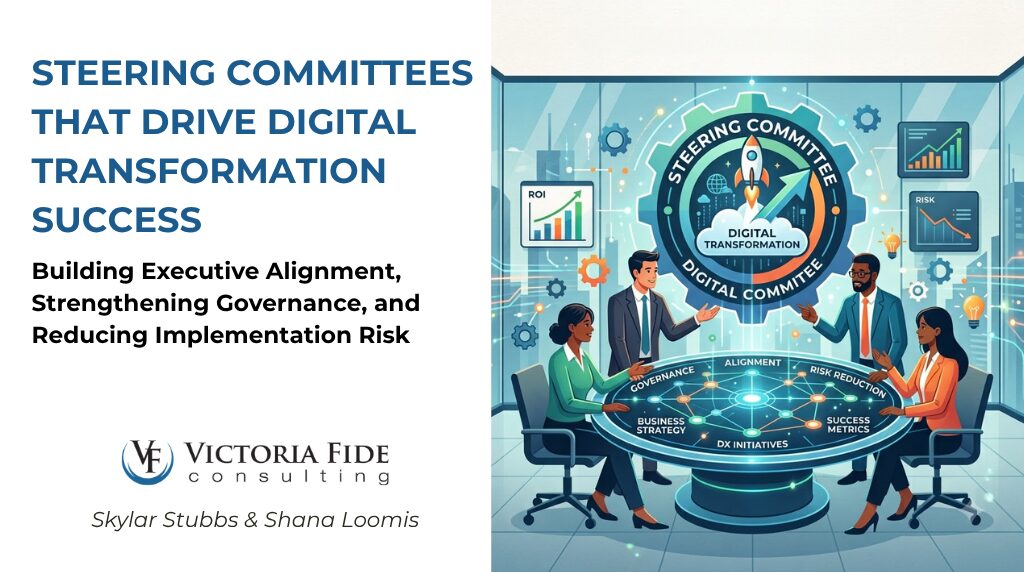
Why Steering Committees Matter More Than Ever

Table of Contents Why Every Digital Transformation Project Needs an Effective Steering Committee Building Executive Alignment to Reduce Risk and...
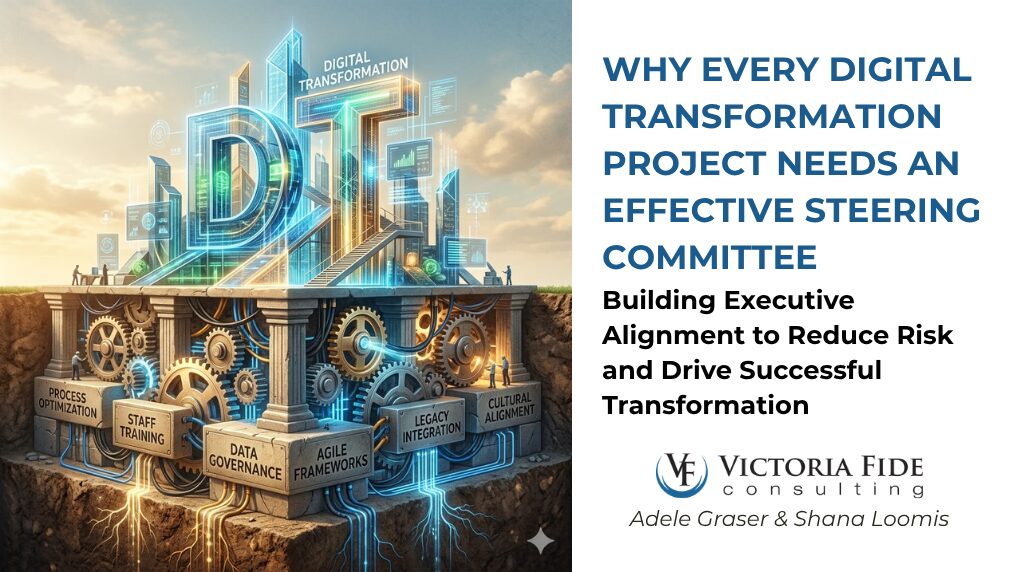
Steering Committees That Drive Digital Transformation Success

Table of Contents Steering Committees That Drive Digital Transformation SuccessBuilding Executive Alignment, Strengthening Governance, and Reducing Implementation RiskWhy Executive Governance...
Addressing Stakeholder Misalignment and Unmet Expectations

Table of Contents Chapter 1: Launching Project Pulsar: Dreams, Doubts, and Digital Transformation Chapter 2: Investigating Team Dynamics: Uncovering Insights...