Change Management Consulting

Your Project Plan Covers the Technology. Who's Covering the People?

Getting the technology right is only half the job. Victoria Fide builds change management into your initiative from the start — preparing your people, aligning every stakeholder, and ensuring your transformation delivers what it promised.

What Victoria Fide Covers

Organizational readiness assessment before the project plan is set

Stakeholder alignment at every level — executive through floor

Communication strategy for internal and external audiences

Role-based training built around process changes, not just the system

Resistance management and adoption monitoring through go-live

88%

of projects with excellent change management meet or exceed their objectives

13%

of projects with poor or absent change management meet or exceed their objectives

Prosci, Best Practices in Change Management

What Change Management Is Actually Supposed to Do

Technology initiatives fail for many reasons — the wrong system, poor project management, unrealistic timelines. But one of the most consistent and preventable causes is underinvestment in the human side of change.

A new system can go live on schedule and on budget, and still not deliver the results the business needed — because the people who have to work differently weren't truly prepared for what was being asked of them. The gap between go-live and realized ROI is almost always a people and process gap, not a technology gap.

Most organizations handle this one of a few ways — and most fall short. They skip change management entirely, assuming people will adapt. They assign it to an internal team member who already has a full-time job. Or they rely on their software implementation vendor, who defines change management as system training and delivers exactly that — and nothing more.

Organizational Change Management done well is a disciplined, structured effort that runs from the earliest stages of a project through post-implementation. It addresses preparation, alignment, communication, adoption, and sustainability — everything that determines whether your transformation actually delivers on what it promised.

The Pattern We See

Change management is treated as an event near go-live rather than a discipline that shapes the entire initiative.

By the time training begins, the decisions that determine whether people will adopt the change have already been made.

Victoria Fide's approach:

Built into your initiative from day one — not layered on at the end.

Built Into Your Initiative. Not Bolted On.

The most common gap in OCM isn't the absence of training — it's the absence of a strategy that accounts for everything that's actually changing.

When an organization implements a new ERP or undergoes a significant digital transformation, the system is only one dimension of the change. Processes are being redesigned. Controls and accountability structures are shifting. Roles are evolving. Reporting relationships may change. The way people interact with customers, vendors, and suppliers is different.

Victoria Fide's change management strategy is built around the full scope of what's changing — not just the technology. That means every person affected understands not only how to use the new system, but why their role looks different, what new expectations exist, and what the organization is asking of them. That's what drives real adoption. That's what produces lasting results.

Comprehensive by Design

Beyond the system — processes, controls, roles, reporting structures, and every stakeholder the change touches.

Embedded From the Start

Change management built into the initiative from the beginning, not added as a late-stage intervention.

Tailored to Your Organization

The change strategy is shaped by your organization's culture, your change landscape, and the full scope of what's being asked of your people.

Sustained Beyond Go-Live

Adoption monitoring and support that continues post-implementation, because go-live isn't the finish line.

Our Change Management Consulting Framework

Victoria Fide has built its OCM approach from the ground up — drawing on proven frameworks including ADKAR and Kotter's 8-Step model, shaped by Tory Bjorklund's experience across hundreds of implementations since 1987 and Adele Graser's firsthand work managing the people side of ERP initiatives in manufacturing and distribution environments.

01

Organizational Readiness Assessment

Before the project plan is finalized, we assess the human factors that will shape how it unfolds — the organization's history with change, where leadership alignment is genuine, which teams are most affected, and where resistance is likely to emerge. This informs the change strategy before work begins.

02

Stakeholder Alignment

Successful change requires alignment at every level — from executive sponsors who need to champion the initiative consistently, to managers who translate the change for their teams, to the peer-level change agents who carry credibility on the floor. We identify, develop, and equip the people at each level who will extend the reach of the change effort across the organization. Genuine buy-in travels person to person, not memo to inbox.

03

Communication Strategy — Internal and External

Our communication planning covers every audience the change touches. Internally, that means differentiated messaging calibrated to what each level of the organization needs to hear, through the right channels, at the right time. Externally, that means customers, vendors, and suppliers whose interactions with your business are affected by the change — built into the plan from the beginning, not notified after the fact.

04

Role-Based Training Strategy

Our training approach starts with a skills gap analysis and builds from there — role-specific, realistic, and built around repetition before go-live. We address process changes, accountability shifts, and new controls alongside system training, because those are equally part of what people need to be ready for.

05

Resistance Management

Resistance is information about where the change strategy needs more work. We address it specifically — listening first, understanding what's actually driving it, and responding with strategies calibrated to the real concern rather than pushing harder on the same message.

Our engagement extends through the Sustain phase because go-live isn't the finish line. We monitor adoption post-implementation, identify where people are struggling, and ensure the changes your organization worked hard to implement actually take hold — and deliver the results that justified the investment.
If you're looking for a company to partner with who has equally mastered the technical and business sides, adapts to your culture and fights for your success just as much as you do, I recommend working with Victoria Fide.
Paul Sorenson Business Systems Analyst, R.D. Offutt Company
Change Management Consulting: Common Questions

Questions about timing, scope, and how Victoria Fide's work fits alongside your existing implementation team.

Earlier than most organizations expect. The instinct is to treat change management as something that happens close to go-live — training rollouts, communication blasts, adoption pushes. By that point, the decisions that determine whether people will actually adopt the change have already been made. The organizational readiness assessment, stakeholder alignment work, and communication strategy all need to be built into the project from the beginning, not layered on at the end. If you're still in the planning phase, that's the right time. If you're already in execution, it's still worth addressing — the later change management starts, the more ground it has to cover.
Implementation vendor training is system training — how to navigate screens, complete transactions, run reports. That's necessary, but it's a fraction of what organizational change management actually covers. OCM addresses why the change is happening and what it means for each person's role, how leadership communicates and models the change throughout the project, where resistance is likely to emerge and how to address it before it becomes a problem, and how adoption is sustained after go-live when the implementation team has moved on. Victoria Fide's change management work runs from the earliest stages of the initiative through post-implementation. Vendor training typically runs for a few weeks before go-live. Those aren't competing offerings — they cover different ground.
Yes. The starting point is an assessment of where the project stands and what the people-side gaps are. From there, Victoria Fide builds and executes the change strategy the remaining timeline allows for. The earlier the engagement starts, the more of the project it can cover — but organizations at any stage of execution benefit from having a structured OCM approach in place for the work that remains. If resistance is already building or adoption is already a concern, those are signals that the right time is now.
Alongside. Victoria Fide's change management work is client-side and complementary to what your implementation vendor is doing. The implementation vendor focuses on configuring and deploying the system. Victoria Fide focuses on ensuring the people who have to work in that system are genuinely prepared for what's being asked of them — and that the organization is set up to sustain the change after the vendor is gone. Those are different bodies of work, and organizations that have both consistently outperform those that have only one.

Don't Leave the People Side to Chance

Whether you're planning ahead or already in an implementation where change management has become a concern, the right time to address it is now.

Change management is built into every ERP implementation engagement Victoria Fide runs. Learn about ERP Implementation Advisory and Support

For organizations where process redesign is driving the change, Business Process Improvement addresses that work directly.

Additional Resources

Building Cross-Functional Alignment

Table of Contents Building Cross-Functional Alignment During Digital TransformationWhy Organizational Alignment Is the Key to Successful ImplementationIntroductionDigital transformation is often...
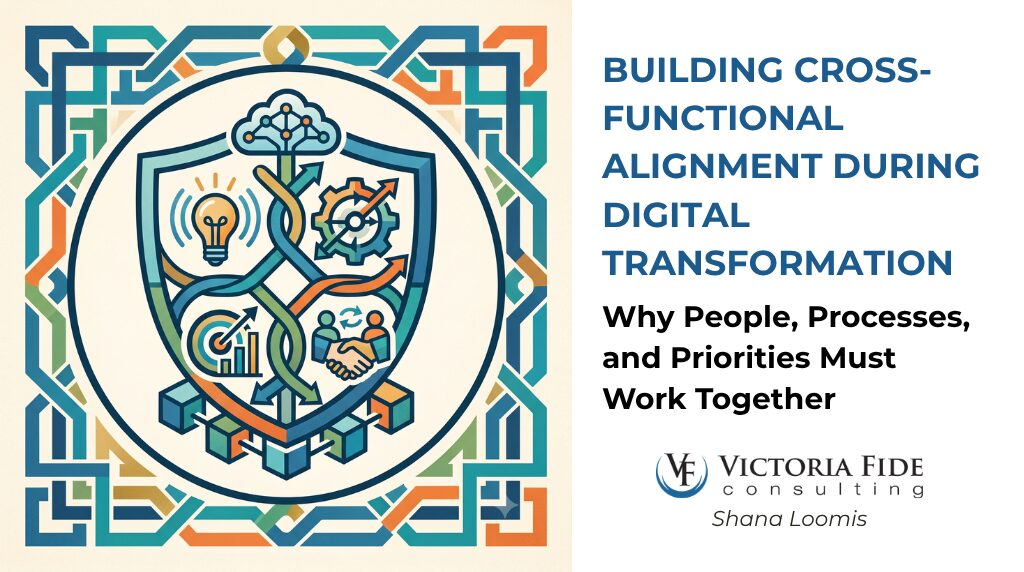
Building Cross-Functional Alignment During Digital Transformation

Table of Contents Building Cross-Functional Alignment During Digital TransformationWhy People, Processes, and Priorities Must Work TogetherWhy Cross-Functional Alignment MattersDigital transformation...

ERP Implementation Best Practices Driving Successful System Adoption and Operational Alignment

Table of Contents Why ERP Implementation Requires Structured ExecutionEnterprise Resource Planning (ERP) systems are central to how organizations manage operations,...