
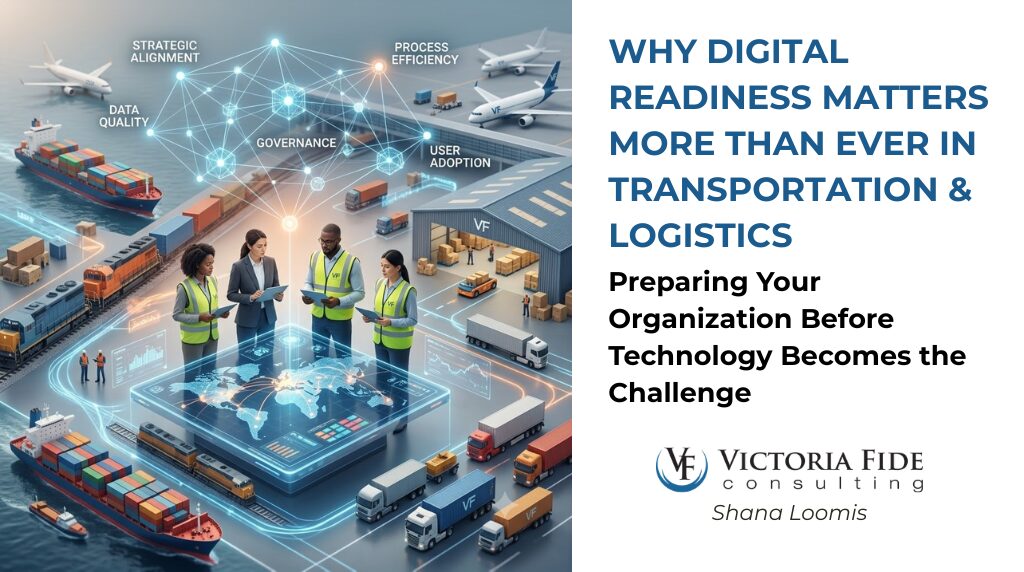
Why Digital Readiness Matters More Than Ever in Transportation & Logistics
Preparing Your Organization Before Technology Becomes the Challenge
Why Digital Readiness Is No Longer Optional
Transportation and logistics companies have always operated in fast-moving environments, but the pace has changed. Customer expectations continue to rise, supply chains have become more complex, and businesses are expected to make better decisions with more information than ever before. At the same time, labor shortages, increasing operating costs, and ongoing market pressures leave little room for inefficient processes.
Many leadership teams are responding by investing in ERP platforms, transportation management systems (TMS), warehouse management systems (WMS), automation, AI, and advanced analytics. Those investments can create significant business value, but only when the business is prepared to support them.
I’ve seen companies spend months selecting new technology only to discover that the larger obstacles had very little to do with the software. Business processes were inconsistent, reporting varied between departments, governance wasn’t clearly defined, and project teams were still trying to answer fundamental operational questions after implementation had already started.
Preparation changes that conversation.
When a business understands its processes, establishes ownership, and creates alignment before implementation begins, new technology has a much better opportunity to deliver the results leadership expects.
The Transportation & Logistics Industry Is Changing
Transportation and logistics operations generate an enormous amount of information every day. Shipments move across multiple locations, inventory changes constantly, customer orders require real-time visibility, and warehouse operations depend on accurate data to keep everything moving.
Collecting information usually isn’t the issue.
Using it consistently across the business is where many companies run into difficulty.
As operations expand, disconnected systems, manual reporting, and inconsistent workflows become more difficult to manage. Teams often spend valuable time reconciling information from multiple sources before they can make decisions, and those delays affect everything from customer service to operational planning.
Adding new technology doesn’t automatically remove those challenges. If underlying processes remain inconsistent, implementation often carries those same issues into the new environment instead of resolving them.
What Digital Readiness Really Means
Digital readiness starts long before implementation.
It reflects how well the business is prepared to introduce new technology, support change across departments, and adopt new ways of working without disrupting day-to-day operations.
Companies that are well prepared typically have several things in place before implementation begins:
- Clear business objectives that guide project decisions.
- Executive leadership actively involved in governance.
- Business requirements that have been reviewed and agreed upon.
- Reliable operational data.
- Consistent business processes across departments.
- Collaboration between leadership, operations, finance, IT, and warehouse teams.
- Employees who understand what will change and how they’ll be supported throughout the implementation.
Technology performs best when it’s supporting a well-prepared business. The stronger the operational foundation, the easier it becomes to implement new systems and sustain improvements after go-live.
Common Challenges Holding Businesses Back
Most transportation and logistics companies experience similar operational issues before beginning a digital transformation initiative. They don’t always prevent implementation from moving forward, but they often create unnecessary complexity once the project is underway.
Disconnected Systems
ERP platforms, transportation management systems, warehouse management systems, CRM platforms, and financial systems frequently operate independently. Teams end up entering the same information multiple times, reporting becomes inconsistent, and gaining a complete view of operations requires more manual effort than it should.
Manual Processes
Spreadsheets, email approvals, and manual workarounds continue to support many daily business activities. They may keep operations moving, but they also increase the likelihood of delays, inconsistent information, and avoidable errors.
Limited Visibility
Leadership depends on timely, reliable information to make operational decisions. When reporting is incomplete or outdated, it’s much harder to respond quickly to changes affecting inventory, transportation, labor planning, or customer service.
Inconsistent Business Processes
Different facilities and departments often complete the same work in different ways. Standardizing those processes before implementation gives project teams a clearer path forward and reduces unnecessary complexity later in the project.
Cross-Functional Alignment
Digital transformation affects nearly every area of the business. Operations, finance, IT, warehouse teams, customer service, and executive leadership all play an important role. When those groups aren’t working toward the same objectives, implementation becomes more difficult to manage and adoption becomes slower across the organization.
Why Readiness Should Come Before Technology
New technology can improve efficiency, increase visibility, and support better decision-making, but it doesn’t solve operational issues on its own.
I’ve seen transportation and logistics companies invest heavily in new systems only to find themselves revisiting business requirements, redefining workflows, or resolving governance issues after implementation was already underway. Those conversations are much easier to have before a project begins than they are once timelines become tighter and project teams are working toward go-live.
Preparing the business first gives leadership a clearer understanding of what’s working today, what needs to change, and where potential risks exist before significant investments are made.
Before moving forward with a new implementation, leadership should have confidence that:
- Business processes have been reviewed and clearly documented.
- Data is accurate enough to support day-to-day operations and reporting.
- Executive priorities are aligned across the business.
- Project teams understand how operations will change.
- Implementation risks have been identified and discussed before they affect the project.
Taking the time to answer those questions early creates better decision-making throughout the implementation and gives project teams a stronger foundation from the start.

How the DX Implementation Risk Assessment Can Help
One of the easiest ways to improve implementation readiness is to understand where potential risks exist before the project begins.
We’ve seen many implementation challenges traced back to issues that could have been identified much earlier with the right preparation. That’s why Victoria Fide developed the DX Implementation Risk Assessment.
The assessment gives leadership a structured way to evaluate six areas that consistently influence implementation success:
- Leadership & Governance Readiness
- Project Management Effectiveness
- Business Requirements Alignment
- Data Management & Readiness
- Testing & Quality Assurance
- Team Support & Change Management
The assessment often confirms areas where leadership already feels confident while also bringing attention to gaps that deserve additional discussion before implementation begins. Identifying those issues early gives project teams more flexibility to address them before they affect schedules, budgets, or user adoption.
For transportation and logistics companies, that preparation creates a clearer path toward implementation, stronger adoption across the business, and better long-term operational performance.
Learn more about the DX Implementation Risk Assessment:
https://victoriafide.com/dx-implementation-risk-assessment/
Why Preparation Creates Better Outcomes
Over the years, we’ve worked with transportation and logistics companies at many different stages of digital transformation. Some are preparing for their first ERP implementation. Others are expanding existing systems, modernizing warehouse operations, or recovering projects that never delivered the business results they expected.
The technology changes from project to project, but one thing remains remarkably consistent.
The businesses that spend time preparing before implementation generally make decisions faster, adapt more effectively when priorities shift, and give their project teams a much stronger opportunity for success. Governance is clearer, communication improves, and implementation becomes much easier to manage because expectations were established early.
That philosophy is reflected in Victoria Fide’s Business & Technology Optimization approach.
We work alongside leadership teams to strengthen governance, improve operational processes, evaluate organizational readiness, and identify implementation risks before they begin affecting project performance. Those conversations create clarity while changes are still manageable instead of forcing project teams to solve preventable issues after implementation is already underway.
Preparation doesn’t eliminate every challenge. It gives businesses a stronger position to respond when those challenges inevitably arise.
Key Takeaways
Transportation and logistics companies continue to invest in new technology to improve efficiency, visibility, and customer service. Those investments deliver the greatest value when they’re supported by strong planning, clear governance, reliable data, and alignment across the business.
The companies that consistently see better implementation outcomes usually have several things in common:
- They prepare the business before implementation begins.
- Executive leadership remains actively engaged throughout the project.
- Business processes and requirements are clearly defined.
- Departments work toward shared priorities instead of competing objectives.
- Employees receive the communication and support needed to adopt new ways of working.
- Implementation success is measured by business outcomes, not simply by reaching go-live.
Technology will continue to evolve, and expectations across the transportation and logistics industry will continue to grow. Businesses that invest in readiness today will be better equipped to adapt, make informed decisions, and get more value from every future technology investment.
Resources
Victoria Fide Resources
DX Implementation Risk Assessment
Evaluate your organization’s readiness before launching a digital transformation or ERP initiative by identifying implementation risks early and strengthening executive decision-making.
https://victoriafide.com/dx-implementation-risk-assessment/
ERP Implementation Recovery
https://victoriafide.com/our-services/erp-implementation-recovery/
Business & Technology Optimization
https://victoriafide.com
Related Victoria Fide Articles
Digital Transformation Challenges
https://victoriafide.com/digital-transformation-challenges/
Defining Your DX Project: Bridging the Gap Between Strategy and Execution
https://victoriafide.com/blog/defining-your-dx-project-bridging-the-gap-between-strategy-and-execution/
What It Takes to Succeed in Digital Transformation
https://victoriafide.com/what-it-takes-to-succeed-in-digital-transformation/
Victoria Fide Thought Leadership
Tory Bjorklund – Chief Executive Officer
This article reflects Tory Bjorklund’s execution-first philosophy, emphasizing implementation readiness, executive governance, operational alignment, and reducing project risk before implementation begins. His leadership reinforces that successful digital transformation starts with aligning business strategy, people, processes, and technology to deliver measurable business outcomes.
Adele Graser – Chief Operating Officer
Drawing from Adele Graser’s expertise in operational leadership, business transformation, and organizational execution, this article emphasizes the importance of executive alignment, stakeholder collaboration, and disciplined execution. Her perspective reinforces that sustainable transformation is achieved by turning strategic vision into operational excellence while delivering measurable business value.
Tammy Plowman – Solutions Architect
Tammy Plowman’s expertise in solution architecture, business process design, and enterprise systems helps organizations bridge the gap between business requirements and technology solutions. Her approach focuses on designing scalable, efficient solutions that align with operational goals, improve performance, and support long-term transformation success.
Skylar Stubbs – Project Manager
Inspired by Skylar Stubbs’ experience in project management and digital transformation delivery, this article highlights the importance of structured execution, stakeholder collaboration, and project governance. His perspective reinforces that successful implementations are built on strong planning, clear communication, and disciplined project execution that keeps initiatives aligned with business objectives.
Shana Loomis – Senior Business Development Manager
Drawing from her background in manufacturing, distribution, supply chain, and business development, Shana Loomis focuses on helping organizations solve real business challenges through practical digital transformation strategies. Her perspective combines operational experience with Victoria Fide’s Business & Technology Optimization approach to help leaders improve readiness, reduce implementation risk, and drive measurable business outcomes.