
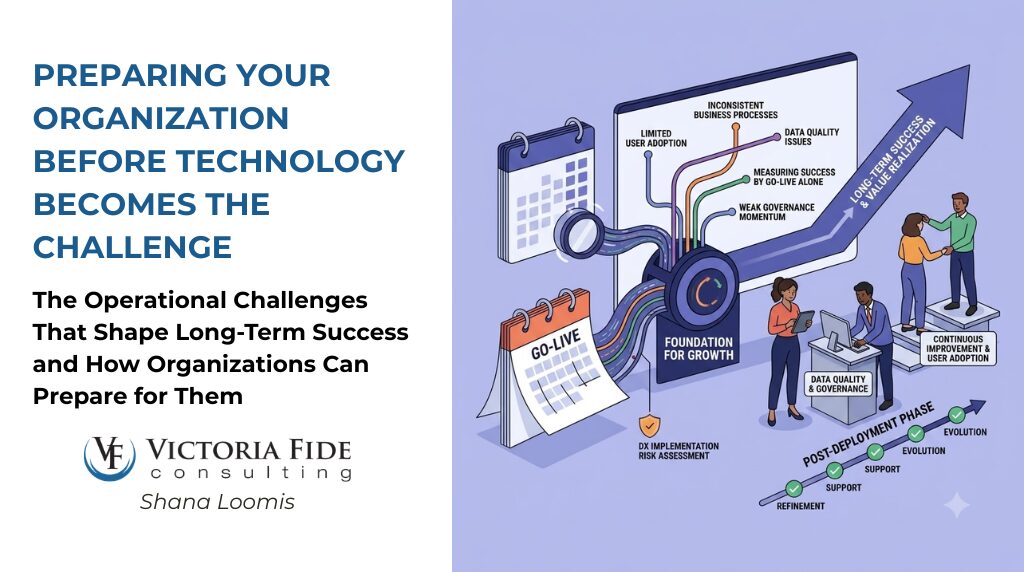
Why Digital Transformation Success Is Decided After Go-Live
The Operational Challenges That Shape Long-Term Success and How Organizations Can Prepare for Them
Introduction
For many companies, go-live represents the end of months—sometimes years—of planning, decision-making, testing, and implementation. It’s a significant milestone, and one worth celebrating. Leadership sees the new system in production, project teams begin transitioning back to their regular responsibilities, and attention naturally shifts toward realizing the value that justified the investment in the first place.
That’s also when many businesses discover the work isn’t over.
I’ve seen implementations that launched on schedule and stayed within budget still struggle to deliver the operational improvements everyone expected. Once employees begin using the system in their daily work, process inconsistencies become more apparent, reporting issues surface, and adoption challenges begin affecting productivity. The technology is functioning as designed, but the business hasn’t fully adapted to the changes that come with it.
Go-live doesn’t create business transformation on its own. It marks the point where the organization begins proving that the investment can produce measurable results.
The companies that continue improving processes, strengthening governance, and supporting users after implementation are the ones that see the greatest long-term return from their technology investments.
Why Go-Live Isn’t the Finish Line
It’s easy to think of implementation as a project with a defined beginning and end. Once the system is live, many organizations assume the hardest work is complete.
In reality, implementation simply moves into a different phase.
Before go-live, project teams work in controlled environments where testing follows planned scenarios and timelines are carefully managed. After deployment, the system becomes part of daily operations. Employees rely on it to serve customers, manage inventory, process orders, analyze financial performance, and support hundreds of decisions that keep the business moving.
That’s when everyday operational challenges begin to surface.
Business processes that seemed clear during testing may not work as expected across every department. Reporting inconsistencies become more noticeable when executives begin relying on dashboards to make decisions. Teams often identify additional training needs once they’re working in real business situations instead of structured testing environments.
None of these challenges necessarily indicate the implementation failed.
They simply reflect the reality that technology is only one part of a successful transformation. Long-term success depends on how effectively the business continues refining processes, supporting employees, and responding to what it learns after go-live.
The strongest implementations don’t end with deployment. They continue evolving as the business gains experience, identifies opportunities for improvement, and adapts to changing operational needs.
The Most Common Post-Go-Live Challenges
Every implementation is different, but the issues that emerge after deployment are often surprisingly similar. While the software may be performing as expected, operational gaps can quickly reduce efficiency if they aren’t addressed early.
Limited User Adoption
Employees may understand how to navigate the system but continue relying on familiar workarounds when new processes haven’t been fully adopted. Spreadsheets, manual approvals, and side processes often reappear because they’re familiar, even when they create duplicate work or reduce data accuracy.
Helping employees understand not only how to use the system but why new processes matter is essential for long-term adoption.
Inconsistent Business Processes
It’s common for departments or locations to perform similar work differently. Those variations may have existed for years without creating significant issues, but they become much more visible after implementation.
When different teams follow different workflows, reporting becomes less reliable, automation is more difficult to maintain, and scaling operations becomes increasingly complex.
Consistent business processes give employees a shared way of working while providing leadership with more dependable operational data.
Data Quality Issues
Many organizations underestimate how much confidence depends on reliable data.
Duplicate records, incomplete information, inconsistent naming conventions, and reporting discrepancies don’t just create frustration. They affect planning, forecasting, customer service, inventory management, and executive decision-making.
Once leadership begins questioning the accuracy of reports, confidence in the system can decline quickly. Addressing data quality should remain an ongoing priority long after implementation is complete.
Executive Governance Loses Momentum
During implementation, steering committees and executive sponsors typically meet regularly to review progress, remove roadblocks, and make project decisions.
After go-live, those meetings often become less frequent as attention shifts to other priorities.
Without consistent executive involvement, improvement initiatives slow down, priorities become less clear, and smaller operational issues can remain unresolved until they become much larger problems. Governance shouldn’t end when the project does. It should evolve alongside the business and continue supporting long-term operational performance.
Measuring Success by Go-Live Alone
Launching on time and within budget is an important achievement, but it isn’t the same as realizing business value.
The more meaningful questions come after implementation.
Are employees working more efficiently? Has reporting improved? Are customers receiving better service? Have manual processes been reduced? Is leadership making faster, more informed decisions?
Those outcomes determine whether the implementation is creating measurable value, and they can only be evaluated once the system becomes part of everyday operations.

Why Challenges Continue After Go-Live
When post-go-live issues begin affecting operations, they rarely appear without warning. In most cases, they’ve existed throughout the project but weren’t fully addressed before implementation.
I’ve worked with leadership teams that assumed reporting issues were caused by the new ERP system, only to discover the real problem was inconsistent business processes that had been carried into the new environment. In other cases, adoption stalled because departments had different expectations for how work should be performed, making it difficult for employees to embrace standardized workflows.
The software simply made those issues more visible.
Several factors consistently contribute to post-go-live challenges:
- Business processes were never fully standardized.
- Roles, responsibilities, and ownership remain unclear.
- Executive engagement declines once the implementation project concludes.
- Performance metrics aren’t reviewed consistently enough to identify emerging issues.
- Continuous improvement efforts lose momentum as teams return to daily responsibilities.
- Employees receive limited follow-up training after the initial rollout.
None of these challenges are unusual, but they become increasingly difficult to resolve if they’re ignored. Small operational issues can gradually affect reporting, productivity, user confidence, and decision-making across the business.
The organizations that respond most effectively don’t treat these issues as implementation failures. They view them as opportunities to strengthen operations, improve processes, and continue building on the investment they’ve already made.
Building a Foundation for Long-Term Success
Digital transformation doesn’t end with deployment. The most successful companies treat implementation as the beginning of continuous operational improvement rather than the conclusion of a technology project.
Once employees begin working in the new environment, leadership gains valuable insight into what’s working well, where processes need refinement, and which areas require additional support. Those observations create opportunities to improve performance while the system is still evolving alongside the business.
Long-term success comes from maintaining the same level of discipline after go-live that existed during implementation.
Leadership should continue reviewing:
- Business processes to ensure they’re being followed consistently.
- User adoption and opportunities for additional coaching or training.
- Operational performance metrics that measure business outcomes, not just system activity.
- Governance priorities that keep improvement initiatives moving forward.
- Reporting quality to ensure executives can make informed decisions with confidence.
- New business requirements that emerge as the organization grows.
Technology will continue to change, and business priorities will continue to evolve. Organizations that regularly evaluate their operations are much better positioned to adapt without disrupting performance or losing momentum.
How the DX Implementation Risk Assessment Can Help
Many of the challenges that surface after go-live can be traced back to decisions made long before implementation ever began.
That’s why Victoria Fide developed the DX Implementation Risk Assessment.
The assessment gives executive teams a structured way to evaluate implementation readiness before technology is introduced, helping identify operational risks that frequently affect project performance and long-term adoption.
The assessment evaluates six areas that consistently influence implementation success:
- Leadership & Governance Readiness
- Project Management Effectiveness
- Business Requirements Alignment
- Data Management & Readiness
- Testing & Quality Assurance
- Team Support & Change Management
One of the biggest benefits of the assessment is that it provides leadership with an objective view of where preparation is strong and where additional attention may be needed before implementation begins.
Identifying those opportunities early gives project teams greater flexibility to address issues proactively instead of managing them under the pressure of an active implementation.
For organizations investing in ERP modernization or broader digital transformation initiatives, that preparation can improve decision-making, reduce implementation risk, and create a stronger foundation for long-term operational success.
Final Thoughts
Go-live is an important milestone, but it shouldn’t be viewed as the finish line.
The months following implementation often determine whether a digital transformation delivers meaningful business value or simply replaces one system with another.
Companies that continue investing in governance, process improvement, employee support, and operational performance are far more likely to achieve lasting results from their technology investments. They recognize that transformation isn’t measured by the day a system goes live, it’s measured by how effectively the business continues improving after implementation is complete.
Preparing for long-term success starts well before deployment, but it doesn’t stop there. Continuous improvement, executive engagement, and operational discipline are what turn a successful implementation into a successful business transformation.
Victoria Fide Resources
Learn More
Digital Transformation Implementation Risk Assessment
https://victoriafide.com/dx-implementation-risk-assessment/
Business & Technology Optimization Services
https://victoriafide.com/
ERP Implementation Recovery
https://victoriafide.com/
Steering Committee Training
https://victoriafide.com/our-services/steering-committee-training/
Related Articles
Steering Committees That Drive Digital Transformation Success
https://victoriafide.com/steering-committees-that-drive-digital-transformation-success/
Why Readiness Should Come Before Technology
https://victoriafide.com/operational-readiness-for-digital-transformation/
Turning Digital Transformation Strategy into Execution
https://victoriafide.com/developing-a-digital-transformation-strategy/
Defining Your Digital Transformation Project
https://victoriafide.com/defining-your-dx-project/
Victoria Fide Thought Leadership
Tory Bjorklund – Chief Executive Officer
Tory Bjorklund’s leadership emphasizes that successful digital transformation begins long before implementation. His focus on executive governance, organizational alignment, and operational readiness has helped organizations reduce project risk while building the foundation for sustainable business performance.
Adele Graser – Chief Operating Officer
Adele Graser brings extensive experience in operational leadership and business transformation. Her approach reinforces the importance of executive alignment, cross-functional collaboration, and disciplined execution to help organizations achieve lasting operational improvements.
Tammy Plowman – Solutions Architect
Tammy Plowman’s expertise in solution architecture and business process design helps organizations align technology with operational goals. Her work focuses on developing scalable solutions that improve efficiency, strengthen performance, and support long-term growth.
Skylar Stubbs – Project Manager
Skylar Stubbs’ experience leading digital transformation initiatives reinforces the value of structured project execution, stakeholder collaboration, and effective governance. His practical approach helps organizations maintain momentum from implementation through long-term operational success.
Shana Loomis – Senior Business Development Manager
Drawing on her experience in manufacturing, distribution, supply chain, and business development, Shana Loomis helps organizations solve operational challenges through practical digital transformation strategies. Her work focuses on improving implementation readiness, reducing project risk, and helping leadership teams achieve measurable business outcomes through Victoria Fide’s Business & Technology Optimization approach.