
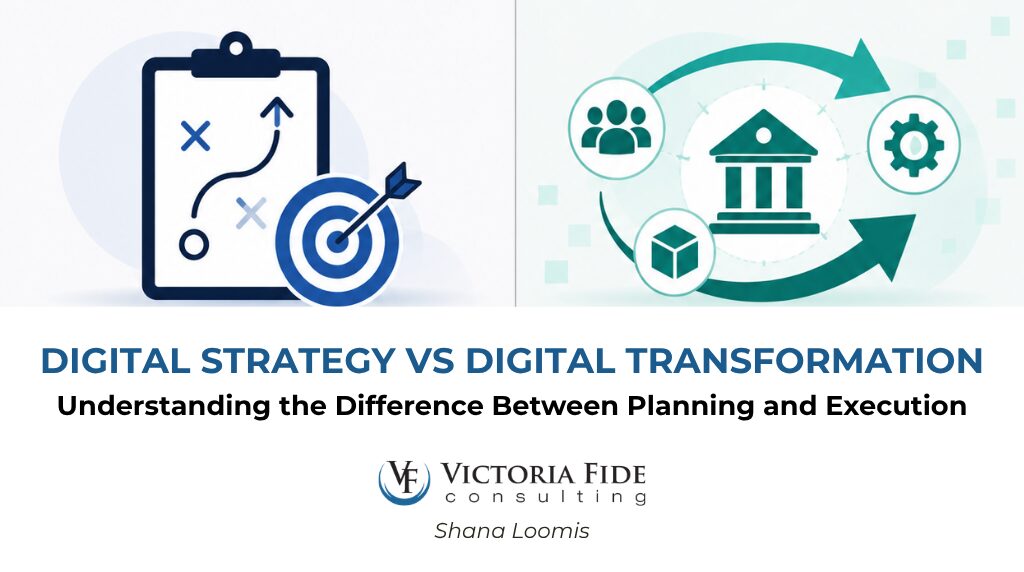
Why Organizations Confuse Digital Strategy and Digital Transformation
Many organizations use the terms digital strategy and digital transformation interchangeably.
While closely connected, they are not the same thing.
This confusion often creates problems such as:
- Technology investments without operational alignment
- Transformation initiatives without clear direction
- Strategies that never move into execution
- Disconnected projects across departments
Organizations that fail to distinguish between strategy and transformation often struggle to achieve measurable outcomes.
Understanding the difference is critical to building transformation initiatives that are both strategic and executable.
What Digital Strategy Actually Means
Digital strategy defines where the organization wants to go and why.
It establishes how technology, data, and operational improvements will support broader business objectives.
A digital strategy typically defines:
- Business priorities and goals
- Competitive positioning
- Technology investment direction
- Customer and operational objectives
- Long-term growth initiatives
Digital strategy answers questions such as:
- What business problems are we solving?
- Where are operational inefficiencies limiting growth?
- What capabilities does the organization need to build?
- How should technology support business performance?
Strategy creates direction and alignment across the organization.
What Digital Transformation Actually Means
Digital transformation is the execution of strategic change across operations, processes, systems, and teams.
It focuses on how the organization:
- Implements new technologies
- Redesigns workflows
- Improves operational efficiency
- Aligns teams and processes
- Drives adoption and measurable outcomes
Transformation is where strategy becomes operational reality.
This includes initiatives such as:
- ERP implementations and optimization
- Process automation
- Data governance improvements
- Workflow redesign
- Operational standardization
Transformation is not simply technology deployment. It is organizational change tied to measurable business outcomes.
The Key Differences Between Strategy and Transformation
While connected, digital strategy and digital transformation serve different purposes.
Digital Strategy Defines Direction
Strategy focuses on:
- Vision
- Priorities
- Objectives
- Investment planning
- Business alignment
It determines what the organization wants to achieve.
Digital Transformation Executes the Change
Transformation focuses on:
- Operational execution
- Process redesign
- System implementation
- Organizational adoption
- Performance improvement
It determines how the organization achieves strategic objectives.
Strategy Without Transformation Creates Stagnation
Organizations often develop strong strategies that never produce measurable change because execution is weak or fragmented.
Transformation Without Strategy Creates Misalignment
Organizations sometimes implement technology or automation initiatives without clear business direction.
This often results in:
- Disconnected systems
- Operational inefficiencies
- Low adoption
- Limited ROI
Successful organizations align both strategy and transformation together.
Why Strategy Without Execution Fails
One of the most common transformation issues organizations face is the gap between planning and execution.
Common breakdowns include:
- Strategies created without operational input
- Technology selected before workflows are optimized
- Lack of ownership across departments
- Weak governance and accountability
- No measurable framework for success
The Victoria Fide article Digital Transformation Challenges explores how these execution gaps impact transformation outcomes:
https://victoriafide.com/digital-transformation-challenges/
A strategy only creates value when it is operationalized effectively.

Aligning Digital Strategy with Operational Transformation
Organizations achieve stronger outcomes when strategy and transformation are aligned from the beginning.
This requires:
- Defining clear business objectives
- Understanding operational workflows
- Aligning technology with business processes
- Establishing governance and accountability
- Measuring performance continuously
The Victoria Fide article Defining Your DX Project: Bridging the Gap Between Strategy and Execution explains how operational alignment improves transformation success:
https://victoriafide.com/blog/defining-your-dx-project-bridging-the-gap-between-strategy-and-execution/
Transformation should not operate independently from strategy. The two must function together as part of a connected business framework.
Measuring Success Across Strategy and Transformation
Organizations should measure both strategic progress and operational execution.
Common metrics include:
- Operational efficiency improvements
- Adoption rates across systems and teams
- Data accuracy and reporting consistency
- Cost reduction and ROI
- Customer and employee experience improvements
Measurement creates visibility into whether transformation efforts are delivering strategic value.
The article What It Takes to Succeed in Digital Transformation highlights how governance and performance tracking sustain transformation success over time:
https://victoriafide.com/what-it-takes-to-succeed-in-digital-transformation/
The Role of Advisors in Strategic Alignment
Many organizations engage advisors to help bridge the gap between strategy and execution.
Advisors can support by:
- Assessing operational readiness
- Structuring transformation roadmaps
- Aligning stakeholders across functions
- Establishing governance frameworks
- Connecting business strategy to operational execution
Firms like Victoria Fide Consulting focus on helping organizations align digital strategy with measurable operational outcomes.
This ensures transformation efforts remain connected to business priorities.
Leadership’s Role in Connecting Vision to Execution
Leadership plays a critical role in ensuring strategy and transformation remain aligned.
Executives drive success by:
- Defining clear priorities and objectives
- Reinforcing accountability across teams
- Allocating resources effectively
- Supporting adoption and organizational alignment
Without leadership engagement, organizations often struggle to sustain transformation momentum.
Next Steps for Aligning Strategy and Transformation
Organizations looking to strengthen transformation outcomes should consider the following steps:
- Define measurable business objectives tied to operational outcomes
- Assess current workflows, systems, and organizational readiness
- Align transformation initiatives with strategic priorities
- Establish governance and accountability structures
- Continuously measure execution and business performance
These steps create stronger alignment between vision, execution, and measurable results.
Resources
Victoria Fide Consulting Resources
Victoria Fide Consulting – Digital Transformation Blue Paper
An execution-focused perspective on digital transformation strategy that emphasizes aligning business objectives, operational processes, and technology decisions to drive efficiency, ROI, and scalable growth.
https://victoriafide.com
Victoria Fide Blog Articles
What It Takes to Succeed in Digital Transformation
https://victoriafide.com/what-it-takes-to-succeed-in-digital-transformation/
Defining Your DX Project: Bridging the Gap Between Strategy and Execution
https://victoriafide.com/blog/defining-your-dx-project-bridging-the-gap-between-strategy-and-execution/
Digital Transformation Challenges
https://victoriafide.com/digital-transformation-challenges/
Leadership & Strategy Thought Leadership
The Digital Transformation Guidebook – Tory Bjorklund (In Progress)
https://bit.ly/DXGuidebookInsider
Industry & Practitioner Resources
McKinsey – Digital Strategy & Transformation
https://www.mckinsey.com
Gartner – Business & Technology Strategy Research
https://www.gartner.com/en/insights
Microsoft – Digital Transformation & Operational Alignment
https://www.microsoft.com/industry/blog/
SAP – Business Transformation & ERP Strategy
https://www.sap.com/insights.html