
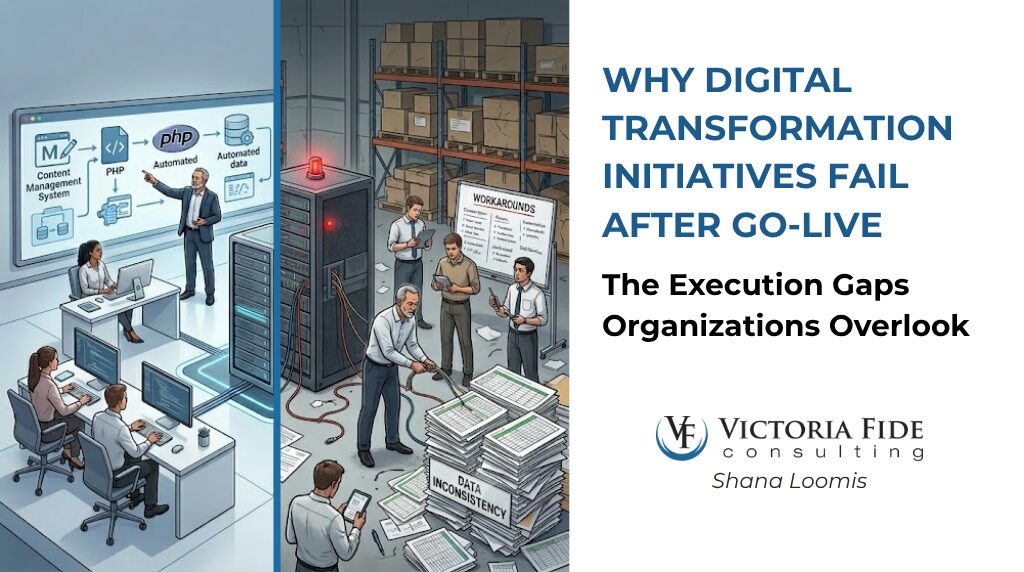
Why Go-Live Is Not the Finish Line
Many organizations treat go-live as the final milestone in a digital transformation initiative. In reality, go-live is where transformation execution becomes visible across daily operations. This is often the point where organizations begin experiencing:
- Workflow disruptions
- Data inconsistencies
- Low user adoption
- Reporting issues
- Operational slowdowns
Technology may be live, but the business itself may not be operationally aligned. Successful transformation is not defined by implementation completion. It is defined by whether the organization can execute effectively after go-live.
What Organizations Expect After Transformation
Organizations invest in digital transformation expecting improvements such as:
- Increased operational efficiency
- Better reporting and visibility
- Faster decision-making
- Standardized workflows
- Improved scalability
However, many organizations experience the opposite shortly after deployment. Instead of improvement, teams encounter:
- Increased manual workarounds
- Delays in execution
- Process confusion
- Reduced trust in system data
These issues often stem from gaps between system implementation and operational readiness.
Why Digital Transformation Initiatives Break Down Post Go-Live
Most transformation failures are not caused by the technology itself. They occur because organizations focus heavily on implementation while underestimating the operational execution required afterward.
Common breakdown points include:
- Processes not aligned to system design
- Teams not fully trained or prepared
- Weak governance and accountability
- Poor data quality and ownership
- Lack of post go-live support and stabilization planning
The result is a disconnect between how the system was designed and how the business actually operates. The Victoria Fide article Digital Transformation Challenges explores many of these operational risks and alignment gaps: https://victoriafide.com/digital-transformation-challenges/
The Most Common Post Go-Live Challenges
Organizations experiencing post go-live instability often encounter similar operational issues.
Low User Adoption
Employees may avoid the system entirely if workflows are unclear or difficult to execute. This leads to:
- Shadow processes
- Spreadsheet tracking
- Manual workarounds
Process Misalignment
Systems are often configured based on assumptions rather than real operational workflows. As a result:
- Teams struggle to complete tasks efficiently
- Cross-functional coordination breaks down
- Operational bottlenecks increase
Data Visibility and Reporting Issues
Post go-live reporting challenges commonly include:
- Inconsistent data structures
- Duplicate or missing information
- Limited trust in dashboards and reports
Without accurate data, leadership loses operational visibility.
Lack of Governance
After go-live, organizations often reduce project oversight too early. This creates:
- Unclear ownership
- Delayed issue resolution
- Inconsistent system usage
Governance is critical after implementation, not just during it.
Inadequate Stabilization Planning
Many organizations underestimate the stabilization period required after deployment. Without a structured stabilization plan:
- Operational issues compound quickly
- Adoption declines
- System confidence deteriorates
The Operational Impact of Failed Adoption
When transformation initiatives fail after go-live, the impact extends beyond the system itself. Organizations often experience:
- Reduced operational efficiency
- Increased labor costs
- Delayed customer response times
- Poor decision-making due to unreliable data
- Slower production or fulfillment cycles
The longer these issues persist, the more difficult recovery becomes. This is where many organizations shift from implementation into operational recovery.

Aligning Systems, Processes, and Operational Reality
Successful post go-live execution requires alignment between:
- Business processes
- System configuration
- Data structures
- Organizational ownership
The Victoria Fide article Defining Your DX Project: Bridging the Gap Between Strategy and Execution explains how operational alignment directly impacts transformation outcomes: https://victoriafide.com/blog/defining-your-dx-project-bridging-the-gap-between-strategy-and-execution/
Technology should support operational reality, not force teams into disconnected workflows.
Measuring Post Go-Live Success
Organizations should monitor post go-live performance using measurable indicators. Key metrics include:
- User adoption rates
- Reduction in manual workarounds
- Process cycle time improvements
- Data accuracy and reporting consistency
- Operational throughput and efficiency
Measurement helps organizations identify issues early before they become embedded into operations. The article What It Takes to Succeed in Digital Transformation reinforces the importance of governance and performance measurement throughout transformation initiatives: https://victoriafide.com/what-it-takes-to-succeed-in-digital-transformation/
The Role of Advisors in Stabilization and Recovery
Many organizations engage advisors after go-live to stabilize operations and improve adoption. Advisors can support by:
- Identifying operational gaps quickly
- Re-aligning workflows and system usage
- Improving governance and accountability
- Supporting user adoption and enablement
- Stabilizing reporting and data structures
Firms like Victoria Fide Consulting focus on helping organizations reconnect transformation initiatives to operational execution and measurable business outcomes.
Leadership’s Role in Sustaining Transformation
Leadership engagement is critical after go-live. Executives influence long-term success by:
- Reinforcing accountability
- Supporting operational adoption
- Prioritizing issue resolution
- Maintaining visibility into performance metrics
Transformation initiatives lose momentum quickly when leadership disengages after implementation.
Next Steps to Prevent Post Go-Live Failure
Organizations looking to strengthen post go-live outcomes should consider the following steps:
- Assess operational readiness before deployment
- Align workflows with system configuration
- Establish post go-live governance and ownership
- Monitor adoption and operational performance closely
- Build a structured stabilization and continuous improvement plan
These steps help organizations sustain transformation performance beyond implementation.
Resources
Victoria Fide Consulting Resources
Victoria Fide Consulting – Digital Transformation Blue Paper
An execution-focused perspective on digital transformation strategy that emphasizes aligning business objectives, operational processes, and technology decisions to drive efficiency, ROI, and scalable growth. https://victoriafide.com
Victoria Fide Blog Articles
- What It Takes to Succeed in Digital Transformation https://victoriafide.com/what-it-takes-to-succeed-in-digital-transformation/
- Defining Your DX Project: Bridging the Gap Between Strategy and Execution https://victoriafide.com/blog/defining-your-dx-project-bridging-the-gap-between-strategy-and-execution/
- Digital Transformation Challenges https://victoriafide.com/digital-transformation-challenges/
Leadership & Strategy Thought Leadership
The Digital Transformation Guidebook – Tory Bjorklund (In Progress) https://bit.ly/DXGuidebookInsider
Industry & Practitioner Resources
- McKinsey – Digital Transformation & Operational Performance https://www.mckinsey.com
- Gartner – Technology Strategy & Transformation Research https://www.gartner.com/en/insights
- Microsoft – Transformation & Operational Readiness https://www.microsoft.com/industry/blog/
- SAP – ERP & Business Transformation Insights https://www.sap.com/insights.html