
Why Digital Transformations Fail After Go-Live
Go-live gets treated like a finish line. The system is configured, the data is migrated, the team cuts over, and everyone breathes out. But go-live isn’t so much a finish line as it is the boundary between two very different phases of the work, and what happens on the other side of that boundary determines whether the transformation actually took hold or quietly comes apart.
In our Process for Transformational Change™, we call that phase Sustain, the third and final stage, following Prepare and Execute. In our experience, it’s also the stage most likely to get shortchanged, not because anyone plans for it to fail, but because everyone assumes the hard part is already over. Most implementation plans end shortly after go-live. There may be a plan for enhanced support, maybe some additional end-user training, but there’s rarely a real plan to assess whether the business actually got what it paid for. Companies spend millions of dollars and endure months of sleepless nights, and then they simply move on without ever confirming the transformation delivered what it promised.
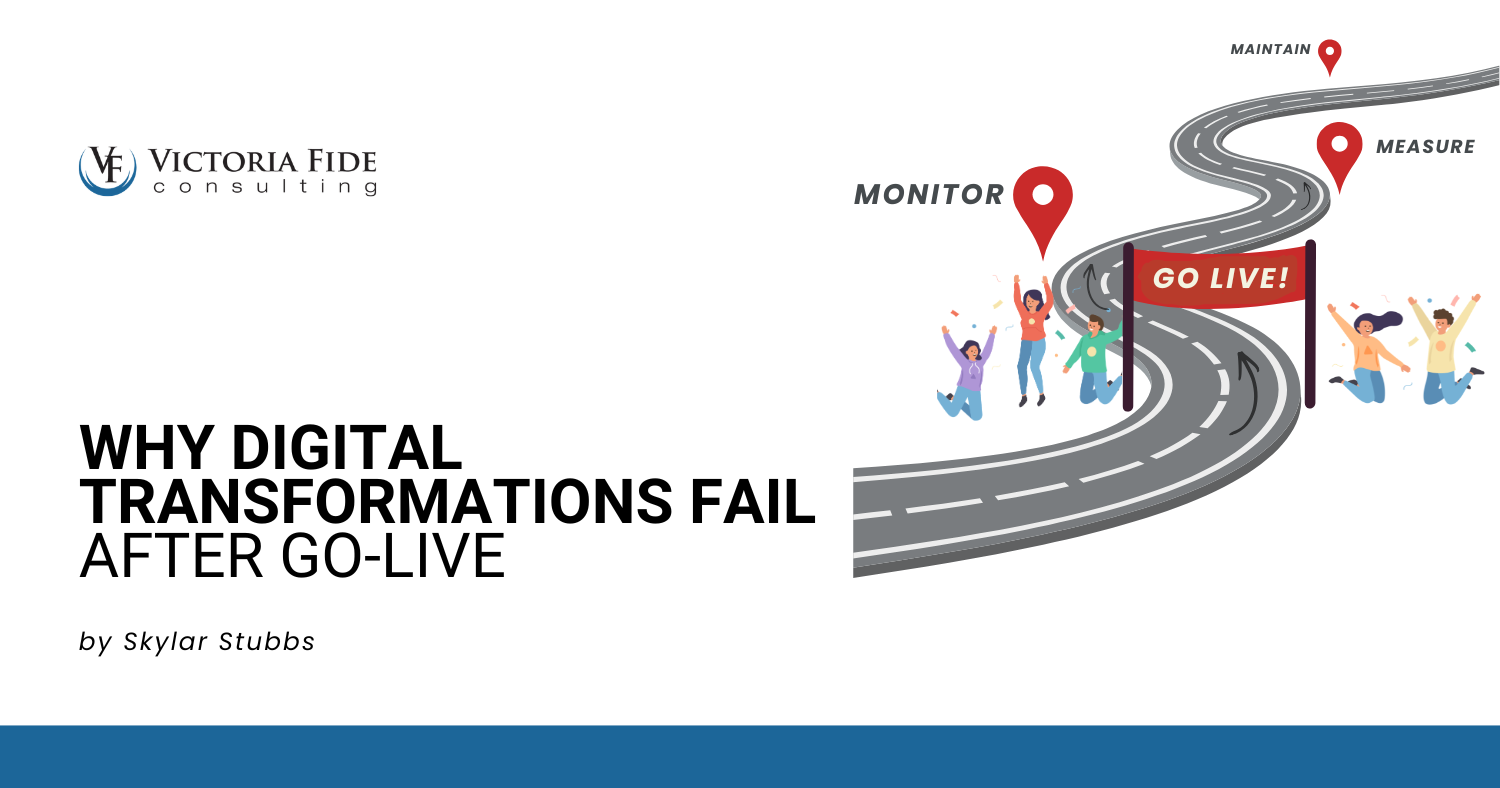
Sustain breaks down into three steps: Monitor, Measure, and Maintain. When any of them gets skipped, two failure modes show up again and again.
Failure Mode #1: Adoption Erodes When Monitor Stops
Training often happens once, usually right before go-live, and then the reinforcement stops. Without ongoing training and monitoring of how the system is actually being used, people revert to whatever got them through the day before: old habits, side spreadsheets, informal workarounds that were only ever meant to be temporary.
I’ve seen this play out firsthand. In the early weeks after a go-live, a few teams built manual workarounds to cover some rough edges in the new process — a temporary spreadsheet here, a manual approval step there. The intent was clear and, honestly, reasonable: bridge a two-to-three month gap while the underlying fixes got prioritized and released.
What actually happened is a familiar story. The project team wound down, attention shifted to the next engagement, and the workarounds just… stayed. There was no Monitor step in place to catch that the “temporary” fix was still running, and no one whose job it was to ask whether it was still needed. Months later, those workarounds had become fully load-bearing parts of the daily process, undocumented, unsupported, and invisible to anyone looking at the system from the outside. The system looked adopted on paper, even though underneath it, the reality was a shadow process running in parallel.
The warning signs are usually visible if someone’s watching for them: help desk tickets that continue to pile up instead of decline, workarounds that spread from one team to another, key users who go quiet in feedback sessions because they’ve already built and normalized their own fix. None of it is dramatic on its own, but taken together it’s quiet erosion, exactly the kind of drift the Monitor step is supposed to catch.
Failure Mode #2: Ownership Gets Lost in the Handoff
The second failure mode is structural. The project team disbands, and no one is left clearly holding the system. During Execute, there’s a steering committee, a decision-making cadence, a clear escalation path. All of that tends to dissolve right at the moment it’s needed most — when real usage starts surfacing the issues that the testing never caught.
This is often where organizational change management quietly stops, too. Teams invest in training and adoption work to get through go-live, but the strategic change management effort that got people bought in during the Execute phase doesn’t carry forward into the Sustain phase. Without continued attention, adoption naturally regresses toward whatever’s easiest, and there’s no governance structure left to notice or correct it.
Without a named owner, issues get logged but nobody has the standing to prioritize or resolve them, so they sit in a queue instead of getting addressed. The people who could fix them don’t know they’re expected to, and the people raising them assume someone, somewhere, is handling it.

Sustain isn’t an afterthought — it’s three deliberate steps
Here’s what those three steps actually look like in practice, and why skipping any one of them opens the door to exactly the two failures above. Prepare lays the foundation. Execute builds and deploys. Sustain is where the change either takes root or unravels, and it’s not passive by design.
Monitor means watching organizational acceptance, business process conformity, and system health after go-live. A successful implementation can still turn into a failed project if the system isn’t being used, isn’t being used correctly, or is quietly generating a pile of workarounds nobody’s tracking.
Measure means holding the initiative against the expectations and success criteria that justified it in the first place. Time and budget are the easiest things to measure, but they’re not the ones that matter most. If the initiative was funded on the promise of specific business outcomes, those outcomes need real key performance indicators — for transformation success, business process effectiveness, and transformation completeness — or nobody will ever know if the goals were actually met.
Maintain means recognizing that most transformational opportunities aren’t realized in a single initiative. Even a successful transformation needs another one behind it before too long, just to keep pace with the market. Maintain is about building the long-range roadmap and the continuous improvement habit, not just closing the project.
Skip any of these three, and the two failures above stop being exceptions and start being the default outcome.
How adoption and ownership feed each other
An ownership vacuum is what makes the adoption problem invisible in the first place. If no one is watching for drift, if Monitor never gets set up as an ongoing discipline, no one catches it early. The workaround that was supposed to last eight weeks becomes the new normal precisely because there’s no one whose job it is to ask whether it’s still needed, and no Measure step confirming whether the original business case is still being realized.
That’s the core of it: Sustain isn’t passive, it’s something that should be very intentional if you want to reap the benefits of your investment.
What to watch for in the first 90 days
Leadership doesn’t need a dashboard to catch this early. A few honest questions go a long way:
- Are there workarounds from week one still in use in month three, and does anyone know why? Is there an actionable plan to resolve them?
- Is there a single person who could tell you, right now, who owns this system?
- Are help desk tickets trending down, or just holding steady?
- Do you have KPIs in place that would actually tell you if the original business case is being realized, or just time-and-budget numbers from the project itself?
If the answers are uncomfortable, that’s useful information. It’s a lot cheaper to course-correct in month three than to discover in month twelve that the “temporary” fix has become the process.
None of this takes a bigger budget or a longer project plan, just treating Sustain as a phase of work, with an owner and a rhythm, rather than the silence that follows a job well done. But if the workarounds in your organization have already outlasted their two-to-three month shelf life, or if you couldn’t say with confidence who owns your system today, you’re past the point where a checklist fixes it. That’s exactly the gap our ERP Implementation Recovery service is built to close: reassessing where things actually stand, rebuilding ownership and adoption, and getting you back to a system that delivers what it was supposed to. Reach out, and let’s find out where you stand.