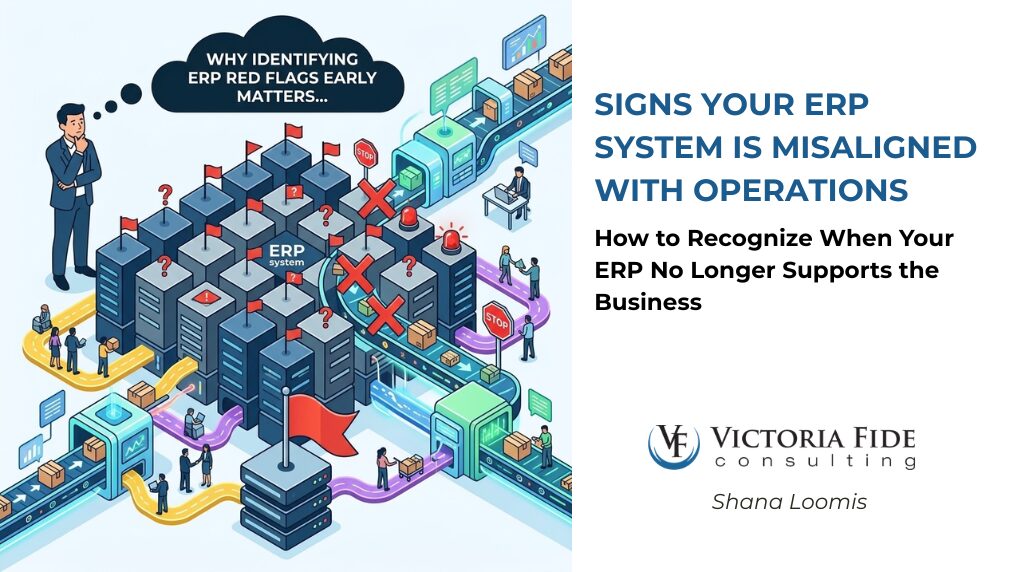
Signs Your ERP System Is Misaligned with Operations
How to Recognize When Your ERP No Longer Supports the Business
Introduction
An ERP system should make running the business easier. It should connect departments, support consistent processes, improve reporting, and give leadership reliable information for decision-making.
The problem is that businesses change much faster than ERP environments sometimes do.
Companies grow. Products and customer requirements change. Acquisitions introduce new processes. Operations become more complex, and employees adjust the way they work to keep everything moving. The ERP may still be functioning exactly as designed while becoming increasingly disconnected from the business around it.
That disconnect doesn’t always look like a technology problem. It might be another spreadsheet created to track inventory, an approval handled through email because the ERP workflow takes too long, or a report that has to be manually corrected before leadership can use it.
Eventually, those workarounds stop feeling temporary. They’re simply how work gets done.
That’s why there’s an important difference between a functioning ERP and an effective ERP. The real question isn’t whether the system works. It’s whether the system still supports the way the business needs to operate.
Seven Signs Your ERP Is Misaligned with Operations
1. Spreadsheets Have Become a Second ERP
Spreadsheets aren’t inherently a problem. The concern is what employees are using them for.
When teams routinely manage inventory, production schedules, forecasting, purchasing, financial reporting, or other core activities outside the ERP, there is usually a reason. They may not trust the data, reporting could be difficult to use, or current workflows simply don’t fit the system anymore.
The bigger warning sign is when employees use spreadsheets to run the operation and update the ERP afterward.
At that point, the spreadsheet isn’t supplementing the ERP. It’s replacing part of it.
2. The Same Process Works Differently Across the Business
Growth naturally creates some process variation. One facility develops its own purchasing workflow while another handles approvals differently. Finance and operations may even use different definitions for the same metric.
Over time, those differences find their way into the ERP through customizations and exceptions. Now a process problem has also become a system problem.
Before adding another configuration change, leadership should determine whether the technology is limiting the process or whether the process itself needs to be standardized.
Victoria Fide’s article on Operational Readiness for Digital Transformation explores this issue further, particularly how process, data, governance, people, and technology need to be aligned before a business can effectively execute and sustain change.
3. Leadership Doesn’t Trust the Reports
Executives shouldn’t spend meetings debating which report is correct. They should be discussing what the information means and what decisions need to be made because of it.
When ERP reports consistently require manual validation, departments produce different numbers for the same metric, or leadership has learned to question the data before using it, something has broken down.
The cause might be data governance, integrations, inconsistent processes, reporting definitions, or system configuration. Whatever it is, unreliable reporting slows the business down.
An ERP can technically produce reports every day and still fail to provide the visibility leadership needs.
4. Employees Have Built Workarounds Around the System
Employees are remarkably good at finding ways to keep operations moving.
If the ERP doesn’t support something effectively, someone creates an email approval. Another employee builds a spreadsheet. A team starts maintaining a shared document, or data gets entered twice because two systems aren’t communicating properly.
One workaround may not matter much. Across multiple departments, they create an operating environment outside the ERP.
They also tell leadership something useful. Employees aren’t always resisting the system. Sometimes they’re compensating for a disconnect between the technology and the work they’re expected to perform.
This same pattern shows up with outdated business processes. Victoria Fide’s How Legacy Processes Slow Business Growth looks more closely at how manual workarounds, disconnected information, and inconsistent workflows can gradually limit efficiency and scalability.
5. Normal Business Changes Require Major System Effort
Adding a product line, adjusting a workflow, opening another location, integrating an acquisition, or responding to a new customer requirement are normal parts of growth.
They shouldn’t automatically become major ERP projects.
If relatively routine changes require extensive customization, significant consulting support, or layers of manual intervention, leadership should understand why.
Sometimes the technology really has reached its limits. In other cases, years of customizations and process exceptions have made the environment unnecessarily complicated.
Those are two very different problems, and they shouldn’t lead to the same solution.
6. “The ERP Won’t Let Us” Has Become a Common Phrase
“The system doesn’t work.”
“We could do this faster before.”
It’s easy to dismiss those comments as resistance to change, especially when the ERP appears to be working from a technical standpoint. They can also be useful clues.
Employees may be dealing with poor system design, inadequate training, outdated requirements, or processes that were never clearly defined during implementation.
Replacing the ERP won’t automatically fix any of those things.
Before making another major technology investment, leadership needs to understand why employees are struggling. Otherwise, the same governance, process, data, and adoption issues can follow the business directly into the next implementation.
7. The ERP Works, but the Business Results Never Appeared
The implementation was completed. Employees use the system every day. Technically, everything works.
But reporting isn’t significantly better. Manual work hasn’t decreased. Inventory visibility hasn’t improved. Processes aren’t faster, and leadership still doesn’t have the information it expected.
This is where technical implementation success and business success have to be separated.
Go-live proves the system was implemented. It doesn’t prove the business improved.
It’s a problem that can become even more visible after deployment. Victoria Fide’s Why Digital Transformations Fail After Go-Live discusses how workflow disruptions, low adoption, data inconsistencies, reporting problems, and manual workarounds often emerge when system implementation and operational readiness aren’t aligned.
If the ERP is functioning exactly as configured but the expected business results never materialized, another configuration change may not be the answer.
A better question is: Where did the business, processes, people, data, and technology become disconnected?
Why ERP Misalignment Happens
ERP misalignment usually develops gradually.
The business changes while the system remains relatively static. Requirements are added without revisiting older processes. Customizations accumulate. Employees leave and institutional knowledge disappears. Acquisitions introduce new workflows, and training that was thorough at go-live becomes outdated several years later.
Eventually, employees begin adapting the business around the ERP instead of having the ERP support the business.
This is why periodic optimization matters. It isn’t about constantly changing the system or chasing new functionality. It’s about checking that operations and technology are still moving in the same direction.
When Optimization Becomes ERP Recovery
Not every misaligned ERP needs to be replaced, and not every issue requires a full recovery effort.
Sometimes better training, cleaner data, stronger governance, targeted configuration changes, or process improvements are enough.
The situation changes when ERP challenges begin affecting business continuity, project timelines, executive confidence, or the company’s ability to operate effectively.
Victoria Fide’s ERP Implementation Recovery service takes a structured approach to those situations: stop the churn, assess the root causes, plan a new approach, execute the plan, and then sustain the gains. The emphasis on understanding root causes first matters because simply continuing to spend time and resources on a stalled project can compound the problem.
Recovery shouldn’t be about fixing the loudest problem first. It should identify why the problem developed so the business doesn’t recreate it somewhere else.
How Victoria Fide Approaches ERP Misalignment
At Victoria Fide, the first question isn’t: Which ERP should you buy next?
It’s: What does the business need the technology to accomplish?
That distinction changes the conversation.
As a vendor-neutral consulting firm, Victoria Fide looks at business strategy, operations, processes, people, and technology together. Depending on what that evaluation uncovers, the answer may be optimizing the existing ERP, recovering a struggling implementation, or determining that the technology truly has reached its limits.
The solution comes after understanding the problem.
That helps prevent a company from making another significant technology investment only to recreate the same operational challenges in a different system.
How the DX Implementation Risk Assessment Can Help
Many ERP problems can be traced back to gaps that existed before implementation.
Victoria Fide’s DX Implementation Risk Assessment provides a structured way to evaluate those risks across six areas: leadership, project management, requirements, data management, testing, and team support/change management.
For businesses preparing for an ERP initiative, the assessment can identify risks before implementation begins. For companies already experiencing problems, those same areas can help leadership understand where alignment may have broken down.
Sometimes the most valuable next step isn’t another technology decision. It’s getting a clearer picture of what’s actually at risk.
Final Thoughts
An ERP doesn’t need to be broken to hold a business back.
Sometimes the warning signs are sitting in plain sight: the spreadsheet everyone depends on, the report that’s always manually corrected, the approval process living in email, or two facilities doing the same work completely differently.
Those small inefficiencies become expensive when everyone starts accepting them as normal.
When operations and technology begin moving in different directions, replacing the ERP shouldn’t automatically be the first move.
Understand where the disconnect happened. Then decide what actually needs to change.
A functioning ERP is only part of the equation. The real measure is whether it’s still helping the business perform better.
Victoria Fide Resources
- ERP Implementation Recovery — Victoria Fide’s approach to identifying root causes, stabilizing troubled ERP implementations, and sustaining the gains after recovery.
- DX Implementation Risk Assessment — Evaluate implementation risk across six critical areas and identify where additional attention may be needed.
- Operational Readiness for Digital Transformation — A deeper look at process, organizational, data, governance, and change readiness.
- How Legacy Processes Slow Business Growth — How outdated workflows and manual workarounds can limit efficiency and scalability.
- Why Digital Transformations Fail After Go-Live — Why operational issues often surface after the technology is already live.
Victoria Fide Thought Leadership
- Tory Bjorklund – Chief Executive Officer
Tory Bjorklund’s approach to digital transformation emphasizes understanding the business problem before changing the technology, with a focus on governance, operational alignment, and measurable outcomes. - Adele Graser – Chief Operating Officer
Adele Graser brings an operational perspective to transformation, emphasizing disciplined execution and connecting strategic objectives with how work actually happens across the business. - Tammy Plowman – Solutions Architect
Tammy Plowman’s expertise in enterprise systems and solution architecture helps connect operational requirements with technology design while keeping scalability and long-term value in focus. - Skylar Stubbs – Project Manager
Skylar Stubbs’ project management experience reinforces the importance of structured execution, stakeholder communication, governance, and accountability throughout transformation initiatives. - Shana Loomis – Senior Business Development Manager
Drawing from her experience across manufacturing, distribution, supply chain, business development, and operations, Shana Loomis brings a practical perspective to what happens when technology and day-to-day operations become disconnected. Her work with Victoria Fide focuses on connecting those challenges with strategies that improve readiness, performance, and measurable business outcomes.