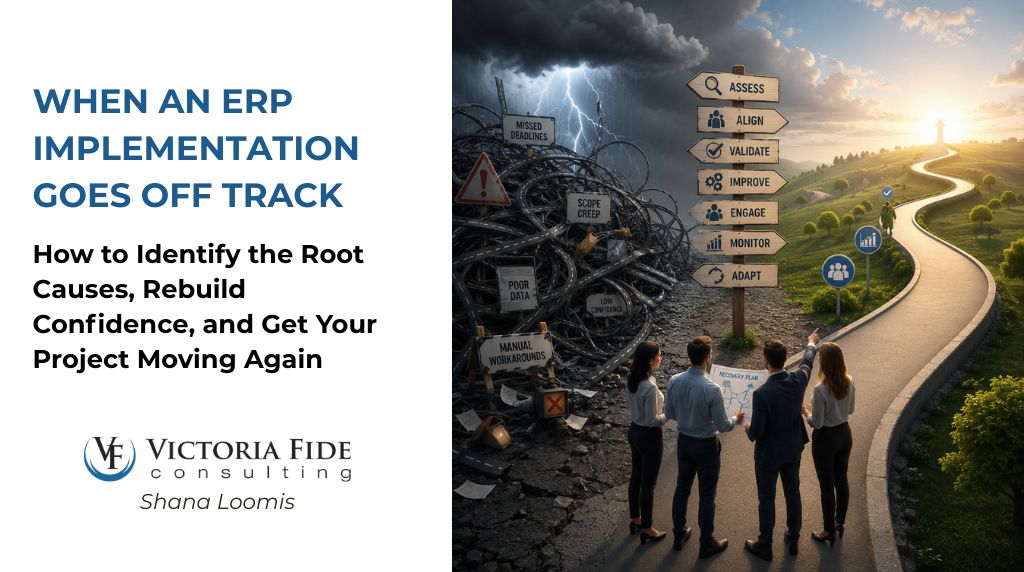
When an ERP Implementation Goes Off Track
How to Identify the Root Causes, Rebuild Confidence, and Get Your Project Moving Again
Introduction
An ERP implementation is one of the largest and most important investments a business can make. By the time a project reaches implementation, leadership has already committed significant time, budget, and internal resources with the expectation that the new system will improve operations, strengthen reporting, and support future growth.
When the project begins losing momentum, that confidence can disappear quickly.
I’ve seen leadership meetings shift from discussing business improvements to debating missed milestones, unresolved issues, and growing implementation costs. Departments become frustrated, users begin looking for workarounds, and the project team spends more time reacting to problems than moving the implementation forward.
That doesn’t necessarily mean the project has failed.
Many struggling ERP implementations can be recovered, but recovery usually starts somewhere unexpected. At Victoria Fide, we’ve found that the most effective recoveries begin by understanding the business before making additional technology decisions. Governance, business processes, executive alignment, and organizational readiness often have a greater impact on project success than software configuration alone.
Taking the time to identify those issues early gives leadership a much stronger opportunity to stabilize the project and restore confidence before costs continue climbing.
When an ERP Implementation Starts to Go Off Track
ERP projects rarely fall apart because of one major event.
More often, small issues accumulate until they begin affecting every part of the implementation. Deadlines slip, requirements continue changing, decisions take longer than expected, and confidence gradually declines across the project team.
Some of the most common warning signs include:
- Project milestones continue slipping without a clear recovery plan.
- Scope changes become increasingly common.
- Departments disagree on priorities or expected outcomes.
- Data quality and reporting issues continue growing.
- Employees return to spreadsheets or manual workarounds instead of using the ERP.
- Executive leadership has limited visibility into project health.
- Testing uncovers recurring process issues instead of isolated system defects.
These symptoms rarely develop in isolation. In many cases, they’re the result of deeper operational issues that existed long before implementation began.
Business requirements may have changed. Governance may no longer be providing clear direction. Legacy processes may have been carried into the new system, or employees may not have received enough support to adopt new ways of working.
Technology often reveals those problems, but it usually isn’t what created them.
That’s why successful recovery starts by identifying the business challenges behind the implementation instead of assuming the ERP system itself is the problem.
As Tory Bjorklund often explains, pushing harder rarely fixes a struggling implementation. Sometimes the fastest way forward is to pause long enough to understand what’s actually preventing the project from succeeding.
Seven Steps to Recover a Struggling ERP Implementation
Every recovery effort is different, but the projects that regain momentum tend to follow a similar path. Before making more technology decisions, leadership should focus on rebuilding the operational foundation that supports the implementation.
Pause and Assess the Current State
When projects begin falling behind, the instinct is often to accelerate. More meetings are scheduled, additional resources are added, and teams work longer hours trying to recover lost time.
A better first step is to pause long enough to evaluate what’s driving the project off course. A focused assessment often prevents months of unnecessary rework later.
Strengthen Executive Governance
Recovery depends on visible leadership.
Executive sponsors should actively remove roadblocks, establish priorities, and ensure decisions support the broader business instead of individual departments. Strong governance restores accountability and helps project teams move forward with confidence.
Validate Business Requirements
Businesses change throughout implementation.
Before additional configuration continues, confirm that the ERP still reflects current business objectives, operational needs, and future growth plans—not assumptions made months earlier.
Improve Business Processes Before Technology
One of the most common recovery mistakes is focusing entirely on software configuration.
In our experience, struggling projects are often rooted in inconsistent business processes, duplicate work, and inefficient workflows that existed before implementation. Improving those processes first creates a much stronger foundation for the technology.
Improve Data Readiness
Reliable reporting starts with reliable data.
Cleaning master data, clarifying ownership, and improving governance increases confidence in reporting while reducing operational issues after go-live.
Rebuild Communication
Recovery depends on transparency.
Leadership, project teams, and business users need consistent communication around priorities, progress, and expectations. Clear communication rebuilds trust while helping every department work toward the same objectives.
Measure Business Outcomes, Not Just Project Milestones
Getting back on schedule is important, but it’s only part of the recovery.
The real measure of success is whether the business becomes more efficient, reporting improves, adoption increases, and leadership gains better visibility into operations.
Recovery Starts with Understanding the Business
One of the biggest misconceptions about ERP recovery is that the software is usually the problem.
In our experience, it rarely is.
By the time an implementation begins struggling, the ERP system is often exposing issues that have existed within the business for much longer. Governance has become inconsistent, business requirements have drifted, departments are no longer aligned, or legacy processes have simply been recreated inside a new system.
Those challenges can’t be solved through system configuration alone.
That’s why Victoria Fide approaches ERP recovery differently.
Before recommending technical changes, we work with leadership to understand how the business operates today. We evaluate executive governance, business processes, organizational readiness, project health, and operational alignment to identify the factors limiting progress. Only then do we determine what technology changes are actually needed.
It’s an approach reflected throughout our ERP Implementation Recovery methodology and one Tory Bjorklund discusses frequently when working with leadership teams. Recovery isn’t about assigning blame or deciding who made the wrong decision. It’s about understanding why the project lost momentum and creating a practical path forward that supports both the implementation and the business behind it.
I’ve found that once leadership has a clear picture of the root causes, decision-making becomes much easier. Teams stop reacting to symptoms and begin solving the issues that are actually preventing the project from succeeding.
How the DX Implementation Risk Assessment Can Help
When an ERP project is under pressure, leadership needs more than another status update. They need an objective understanding of where the risks exist and which issues deserve immediate attention.
Victoria Fide’s DX Implementation Risk Assessment provides that perspective.
The assessment evaluates six areas that consistently influence implementation success:
- Leadership & Governance Readiness
- Project Management Effectiveness
- Business Requirements Alignment
- Data Management & Readiness
- Testing & Quality Assurance
- Team Support & Change Management
For businesses preparing for implementation, the assessment helps identify risks before they affect schedules, budgets, or adoption.
For businesses already experiencing implementation challenges, it provides a structured starting point for recovery by separating technology symptoms from the operational issues driving them. That allows leadership to focus time and resources where they’ll have the greatest impact.
Final Thoughts
An ERP implementation doesn’t become successful simply because it reaches go-live.
It succeeds when the business operates more effectively than it did before the project began.
When an implementation goes off track, pushing harder rarely solves the underlying problem. The better approach is to step back, understand what’s limiting progress, and rebuild the operational foundation supporting the project.
That’s why Victoria Fide views ERP recovery as a business initiative supported by technology, not the other way around.
When governance improves, business processes are strengthened, leadership is aligned, and employees have the support they need, technology becomes far more effective. Recovery isn’t just about getting a project back on schedule. It’s about helping the business achieve the outcomes that justified the investment in the first place.
Victoria Fide Resources
Learn More
ERP Implementation Recovery
When an ERP project begins losing momentum, the right response isn’t always to push harder. Learn how Victoria Fide helps organizations identify root causes, strengthen governance, stabilize implementations, and build a practical recovery strategy focused on long-term business success.
https://victoriafide.com/our-services/erp-implementation-recovery/
Digital Transformation Implementation Risk Assessment
Evaluate implementation readiness and identify project risks before they begin affecting schedules, budgets, and business performance.
https://victoriafide.com/dx-implementation-risk-assessment/
Business & Technology Optimization
Learn how Victoria Fide helps businesses align strategy, operations, and technology to improve performance and support sustainable growth.
Steering Committee Training
Strengthen executive governance and improve decision-making throughout your transformation journey.
https://victoriafide.com/our-services/steering-committee-training/
Related Victoria Fide Articles
- Why Digital Transformation Initiatives Fail After Go-Live
- Operational Readiness for Digital Transformation
- Building Cross-Functional Alignment During Digital Transformation
- Turning Digital Transformation Strategy into Execution
Additional ERP Recovery Insight
ERP Implementation Recovery with Tory Bjorklund
For additional insight into Victoria Fide’s approach to ERP recovery, watch Tory Bjorklund discuss why successful recovery starts with understanding the business before attempting to fix the technology. The discussion explores executive governance, operational alignment, and practical strategies for helping organizations regain momentum when ERP projects begin to struggle.
https://youtu.be/oO2JIQjKp5w?si=H-M4si2Pc9EDDP9t
Victoria Fide Thought Leadership
Tory Bjorklund – Chief Executive Officer
Tory Bjorklund believes successful ERP recovery begins with understanding the business before addressing the technology. His focus on executive governance, operational readiness, and organizational alignment helps leadership teams regain control of struggling implementations while building a stronger foundation for long-term success.
Adele Graser – Chief Operating Officer
Adele Graser brings extensive experience in operational leadership and business transformation, helping organizations restore project momentum through executive alignment, disciplined governance, and practical execution.
Tammy Plowman – Solutions Architect
Tammy Plowman’s expertise in enterprise systems and solution architecture helps businesses align technology with operational goals while creating scalable solutions that support long-term growth.
Skylar Stubbs – Project Manager
Skylar Stubbs’ experience leading complex implementation initiatives reinforces the importance of structured governance, effective communication, and disciplined project execution to keep recovery efforts moving forward.
Shana Loomis – Senior Business Development Manager
Drawing on her experience in manufacturing, distribution, supply chain, and business development, Shana Loomis helps organizations improve implementation readiness, reduce project risk, and achieve measurable business outcomes through Victoria Fide’s Business & Technology Optimization approach.